Explore our strategy towards systemic change to fight impunity.
1. Knowledge is disconnected: Measures put in place for justice and reparations are often detached from the needs of victims and survivors
2. Barriers to meaningful victim participation: Victims and survivors struggle to be involved in a meaningful way in the pursuit of justice
3. Lack of political will: Involving victims in justice at a local and global level are often not a priority
1. Gathering and sharing knowledge with our local and international partners including through research, training, and policy work
2. Building partnerships and coalitions with victims’ organisations to strengthen their voices and demands in relevant policy debates
3. Mobilising joint political action by connecting knowledge and demands from coalitions with relevant policymakers at all levels

Our interventions take place at local/community levels, as well as national, regional and international levels.

A climate of impunity exists when those in power systematically abuse human rights, commit crimes or other misdeeds, and exclude others from opportunities without fear of consequences.
This can happen in the guise of racism, gender inequality, other forms of discrimination, and harsh practices of violent or ‘militarised masculinities’ – within the security sector and beyond.
This has profound consequences for society, in particular for those suffering from conflict and oppression. We must therefore seek to overcome impunity and its root causes together with victims, both locally and globally.
All references to ‘victims’ in the strategic plan and language includes victims, survivors, and communities affected by serious human rights violations and abuses.
What is impunity, and what are the obstacles to overcoming it? How does Impunity Watch work together with victims, survivors and communities affected by human rights violations to transform justice?
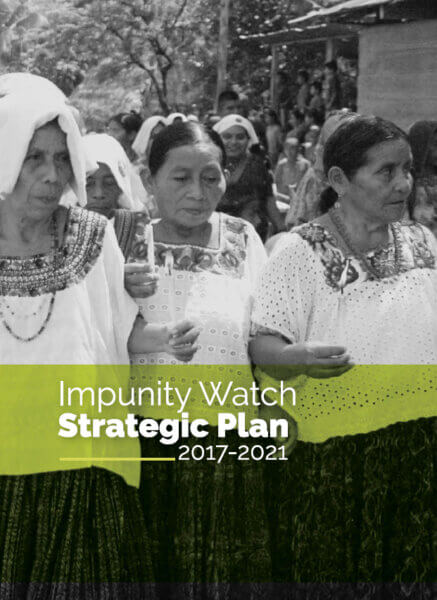
Our strategic plan, including a brand new theory of change visualisation, highlights our programme objectives for the next five years.
Read now (English)
Lea nuestro plan estratégico en español.
Spanish (Español)Lisez notre plan stratégique en français.
French (Français)اقرأ خطتنا الإستراتيجية باللغة العربية.
Arabic (عربي)
Working towards systemic change in partnership with others will guide all our work in the coming years.
At Impunity Watch, we believe that transitional justice practices will have greater impact if they become more innovative, deeply rooted in contextual specifics and that enable the most marginalised to participate in justice processes.


