Our research on Victim Participation

New: Overview report
Impunity Watch

Together with our partners, we gather knowledge on victim participation in both formal and informal transitional justice initiatives across different contexts. We share this knowledge with relevant actors through our policy work, training and capacity building, and communications.

The goal is to provide practitioners, policymakers and victim-led organisations with tools to develop inclusive, accessible and transparent victim participation strategies by:

  1. Demonstrating how victim participation can help overcome impunity and realise transformative justice.
  2. Identifying practical ways to strengthen the role of victims as changemakers. This includes emphasising the need for collective action through victim-led associations, coalitions and solidarity efforts.
  3. Showing obstacles to meaningful victim participation, such as the structural exclusion of marginalised groups like women and youth, and suggesting ways forward.

The research underscores the importance of both formal and informal victim participation in justice initiatives.

“Through organising, our strength increases [and] it becomes easier to demand attention for victims from the state.”
Impunity Watch logo
Guatemalan member of a regional victims’ coordinating council

Victim participation in formal processes 

Our research began with a large-scale comparative project across Burundi, Cambodia, Guatemala, Honduras, Kenya and Tunisia (2014-2018). 

It focused on victim participation in formal justice processes, such as the International Criminal Court (ICC) and various truth commissions.

The research shows that:

  1. Victim participation must be adapted to different contexts
  2. Victim groups must mobilise for effective participation
  3. We put the issue on the international policymaking agenda for the first time

The language from our research was directly adopted by decision makers, including the (former) UN Special Rapporteur for Truth Justice Reparation and Non Recurrence, Pablo de Greiff in multiple reports.

Overview report

Victim participation in informal processes 

Building on findings, we partnered with local organisations to collect lessons learned, experiences and reflections in Colombia, the Democratic Republic of Congo, Guatemala, Indonesia, Syria and Tunisia (2020-2023).

This phase focused on understanding the extent to which victim and survivor participation through informal justice initiatives can create space(s) for activism and play a meaningful part in social change, and its relationship to political agency.

This research demonstrates the value for victims to connect and strengthen their activism through a grassroots approach. The findings are contributing to our policy work. This includes helping develop the UN Secretary General’s ‘Guidance Note on transitional justice’, advocating for victim participation and stressing the importance of collective action to make justice possible.

Overview report

Available in Arabic, Spanish, and French. 

NEW: RESEARCH BRIEF

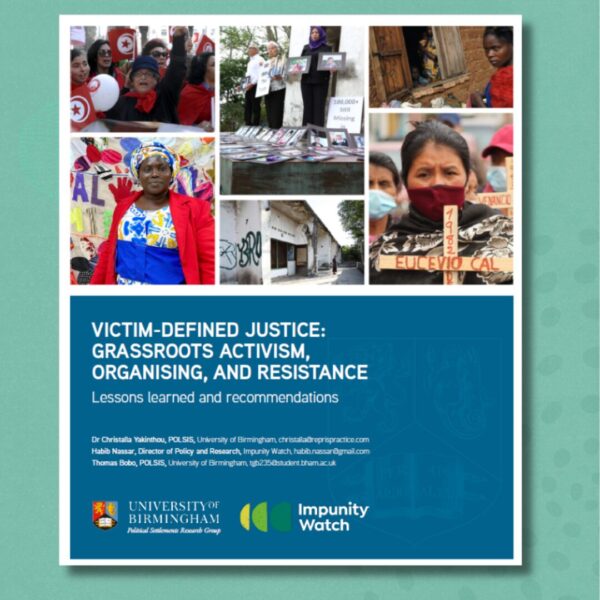
‘Victim-defined Justice’

This research brief explores how informal organising and victim-defined justice can foster change, enhance agency and facilitate community empowerment in justice processes and beyond. It is based on our overview report on victim participation in informal processes. The brief includes summaries from just two of the six case studies, from Colombia and Syria, and discusses key recommendations and lessons learned.

Read the research brief

Key findings of the overview report on informal justice processes:

  1. Long-term, multi-level and equitable partnerships with victim groups are crucial for transformative change
  2. Solidarity is a founding driver behind organising, bringing together diverse justice priorities
  3. Access to knowledge and decision makers as well as meaningful inclusion helps victims and survivors to (re)claim political agency
  4. The most sustainable activism is often linked to access to resources 
  5. Informal transitional justice efforts and activism can be innovative and creative, and generate meaningful change for victims and survivors

Explore the report in multiple languages:

Arabic – عربي    Spanish – Español     French – Français