Gender

We strengthen the participation and influence of women in justice processes, and transform established gender norms that fuel cultures of violence and repression.

Gender is a growing focus of transitional justice processes. Yet in reality, not much is changing to transform the structural inequalities that make certain groups more vulnerable to violence.

It is well established that women and girls, men and boys, and people with diverse gender identities all experience conflict and its aftermath differently, which requires us to adapt responses. In times of violence, women are never mere victims but take on a variety of roles, including leading struggles for justice. Their voices are powerful instigators of societal change.

Impunity Watch seeks to:

  • Strengthen the participation and influence of women and other marginalised groups in justice processes
  • Challenge established gender norms that perpetuate cycles of violence and uphold impunity – such as militarised masculinities

We use a gender-transformative approach in our programmes to address the root causes of gender inequality and sexual and gender-based violence (SGBV), transform underlying stereotypes, and strengthen women’s participation in wider political arenas.

NEW

Policy report

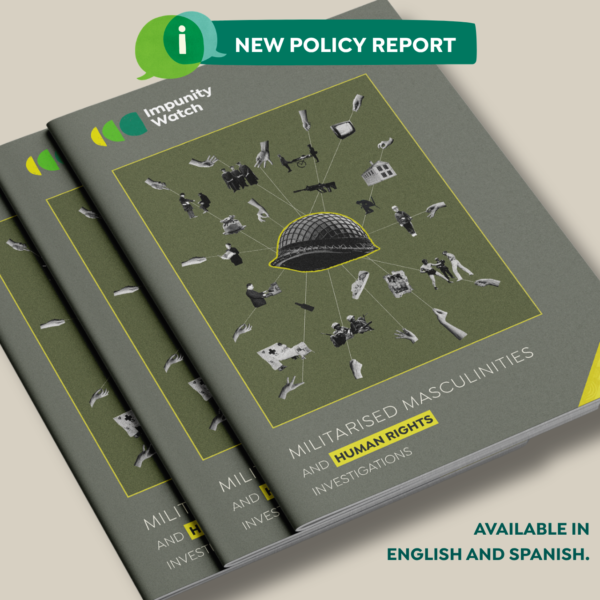
Militarised masculinities normalise cycles of conflict and, enable human rights violations and impunity, and prevent justice and accountability.

Our new policy report offers practical guidance for Human Rights Inquirers – including Commissions of Inquiry, Fact-Finding Missions or other accountability mechanisms – to address militarised masculinities as root causes of violence and impunity, throughout all phases of investigative processes.

Read it now
Learn more about what we mean when we use the following terms.

Key concepts

An organising force of social, political, and economic life. Gender is a relational construct that refers to the power dynamics among men, women, trans and intersex people. It also relates to the socially constructed roles of these groups, and how their activities and behaviours are differently valued.

Threats or acts of violence (physical, sexual, psychological, etc.) directed towards or disproportionately affecting someone because of their sex or gender, including perceived transgressions of the gender norms in their community or society.

Note: This is not limited only to violence against women, as LGBTQI people and men can also suffer violence.

The different forms, characteristics, and symbols considered masculine. They are not all valued equally.

  • The most highly valued, hegemonic masculinity prioritises the use of reason over emotions, being strong and fearless, being economically successful, and actively heterosexual. Maintaining this image entails exercising control over women and less powerful men.
Read our new policy brief

Transformation is complex as experiences are not just defined by gender, but also by other intersecting characteristics (age, class, religion, ethnicity, sexual orientation, able-bodiedness, etc). This requires a thorough analysis of different experiences and causes of social inequalities.

Gender-transformative justice is a long-term project, since change is required at many levels:

  • The individual level of women’s and men’s experiences
  • The collective level of families and communities
  • The broadest level of international social, political, and economic structures

Engaging men in supporting women’s participation and transforming oppressive masculinities is another crucial strategy to promote changes in gender relations.

How can gender inequality be transformed?

Based on Nancy Fraser’s model of trivalent justice (2008), we believe that change can be promoted in different, but highly interconnected ways:

  1. Recognition of women’s and men’s diverse experiences of conflict, as well as the need for transformation of societal ideas and stereotypes that negatively affect them
    Examples: Historical memory processes or truth commissions
  2. Redistribution of economic and other resources within society is needed to enable women more equal access and opportunities
    Examples: Transformative reparations
  3. Representation of women must be promoted, both in formal and informal transitional justice processes, as well as their political participation
    Examples: Victim participation and mobilisation in transitional justice

Gender-transformative approaches in practice

Impunity Watch aims to promote these three strategies to our work on various levels.

Our gender-transformative approach enhances our work on victim participation by improving the inclusion of women and marginalised groups in transitional justice processes. We address gender and other types of discrimination that inhibit meaningful participation, and provide technical support to key judicial cases on conflict-related gender-based violence.

In addition, we seek to advance gender-transformative approaches through advocacy at local/community level, as well as the international level, such as through the UN Human Rights Council, UN Security Council, and the African Union.

We also engage researchers and practitioners to examine the connection between hegemonic masculinities and violence and exclusion, for example through our research in Burundi and Guatemala, and formulate policy recommendations. By initiating dialogue on such topics, we aim to demonstrate that alternative expressions of ‘maleness’ and gender that are disconnected from violence or repression can help foster just and peaceful societies.

Through consistent engagement of our partners, we hope to strengthen the implementation of UN Security Council resolutions, such as UNSCR 1325 on women, peace and security, and other gender justice norms.

“There are men who do not commit gender-based violence. They can serve as positive examples for other men.”
Impunity Watch logo
Rivuzimana Jeanette, a woman participant in a training in Burundi

Explore our work on gender-transformative justice