


21 June 2023
A new report, titled Transitional justice in Tunisia from the perspective of women victims highlights the gendered nature of repression experienced by women victims in Tunisia. It underscores the urgent need to address this issue and offers recommendations for policymakers and practitioners. These recommendations aim to strengthen support for the meaningful inclusion and leadership of female survivors and victims in transitional justice processes, while also fostering a broader perspective on the prevention of violations recurrence.
Background
Since the fall of the Ben Ali regime in 2011, Tunisia has been seeking to preserve and consolidate the achievements of the Revolution. Various commissions and institutions were established, including the National Fact-Finding Commission and a National Commission for the Investigation of Corruption and Embezzlement. The Truth and Dignity Commission (TDC) was created to investigate and document human rights violations. Throughout this process, activists and civil society initiatives worked to promote truth, justice and reparations.
The TDC’s framework and women’s associations played a crucial role in empowering women to come forward with their cases, share their stories, and testify in both public and private hearing sessions, revealing to the public the gendered nature of repression and the extent of suffering and systemic violence endured by women.
Violations beyond gender-based violence
This report brings to the forefront a comprehensive understanding of violations against women that extends beyond gender-based violence. It explores the intricate connection between political violence and the everyday lives of women, shedding light on their unique experiences in relation to male victims of torture, imprisonment, or killings. Often overlooked, these women have endured indirect suffering, grappling with adverse economic consequences and encountering barriers to employment and education.
The report also addresses the right to truth, the duty to remember, forgiveness, and reconciliation.The intertwined nature of justice, reconciliation, and recognition forms a vital connection, and the active presence and participation of perpetrators play a pivotal role in averting future violations.
To conduct this study, a diverse range of female victims from various backgrounds and generations were interviewed activists, researchers, and former TDC commissioners.
The new report is the latest addition to a broader multi-year comparative research project entitled Promoting access to justice through victim participation: Foregrounding informal processes, implemented by Impunity Watch and research teams from six countries: Colombia, the Democratic Republic of Congo, Guatemala, Indonesia, Syria, and now Tunisia; and funded by the Ministry of Foreign Affairs of the Netherlands.
The full report can be found in English, Arabic and French.
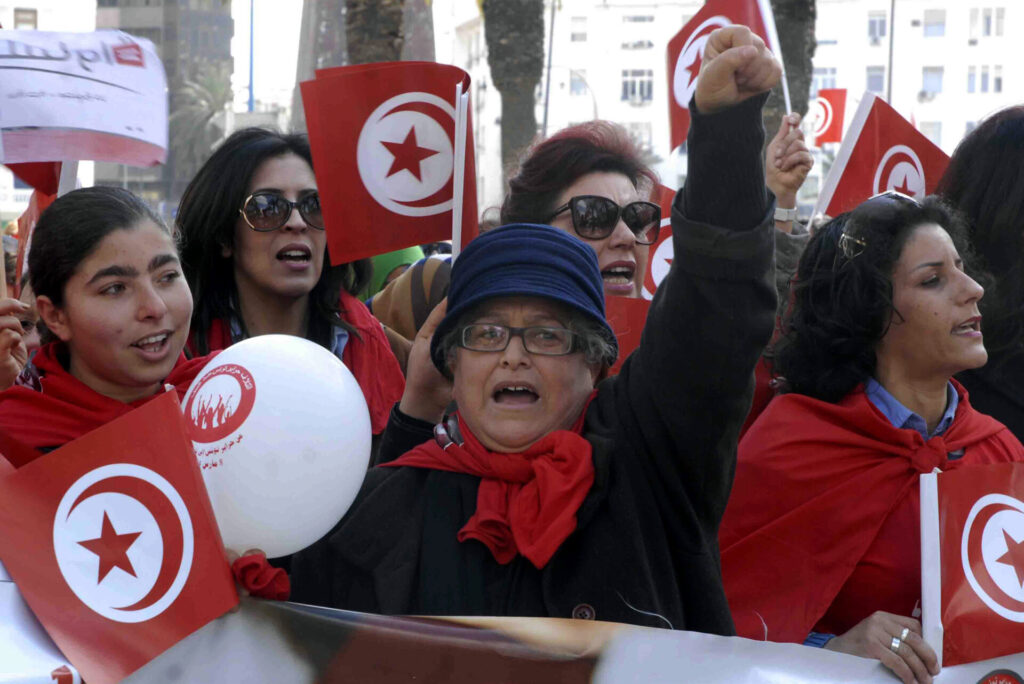
Photo: Tunisians wave national flags and shout slogans during a rally to mark the fifth anniversary of the 2011 Revolution. 14 January 2016. Habib Bourguiba Avenue in Tunis. Credits: © Fethi Belaid/AFP via Getty Images.