Tunisia

In Tunisia, we help fight systemic impunity and strengthen the demands of victims of the dictatorship, especially women and marginalised groups, to ensure their rights are upheld.

Sipa USA (Alamy Stock Photo)

In Tunisia, Impunity Watch works to strengthen the ability of victims of human rights violations and socio-economic injustice to continue demanding respect for their rights and support their participation in transitional justice processes following the 2011 revolution.

This includes providing capacity building, technical, legal, advocacy and communications support to amplify the voices of victims in a political context mostly hostile to transitional justice goals. We also monitor the transitional justice process in Tunisia to alert UN human rights bodies to local developments, and promote an inclusive victim-centered debate on transitional justice. We have been working in Tunisia since 2014.

Our work in Tunisia takes a three-pronged approach:

Victim participation

We ensure that national, regional, and international human rights institutions are more responsive to victims’ needs on the ground and therefore more effective and contribute to strengthening justice efforts for Tunisians.

Gender

We focus on the needs of marginalised groups, especially women and youth, and promote a gender transformative approach in justice processes.

Independent judiciary

As judicial independence is essential in the fight against impunity, we support Tunisian justice actors, including judges of the Specialised Criminal Chambers, whose anti-corruption and justice work is under threat.

Justice & Accountability

Newsletter series

This new series showcases global developments in justice and accountability, backed by evidence and analysis on why these matter for the fight against impunity in Tunisia.

Explore the series

New report

Tunisia faces a turning point, where the legacy of past violations meets the current challenges of justice and accountability.

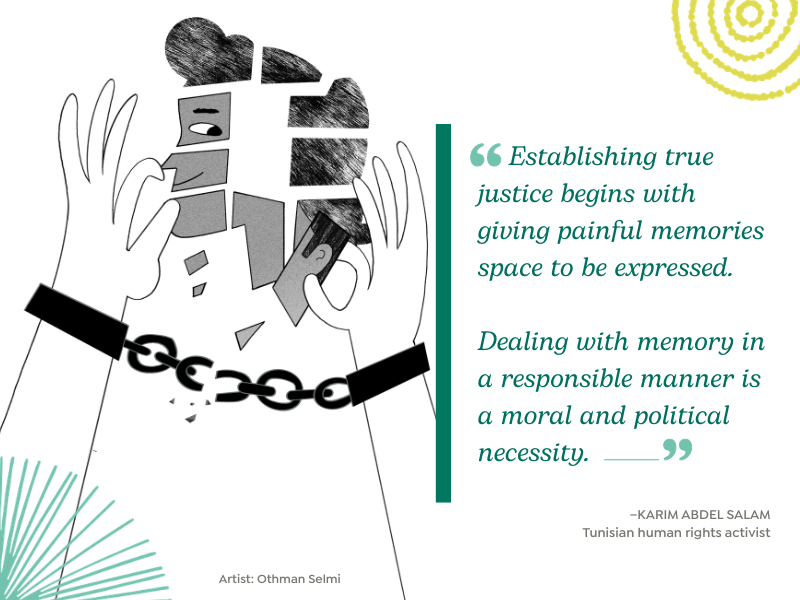
Preserving memory and passing it on to future generations is essential to understand history in depth, ensure recognition for victims, and promote values of truth and accountability.

This Arabic study deals with individual and collective strategies for documenting and preserving memory.

Learn more

English summary coming soon!

“I have chosen the path of resistance against a repressive regime in order to achieve freedom. Today we all need liberation for dignity.”
Impunity Watch logo
Zeineb Cherni, Tunisian activist

Tunisia’s 2011 revolution promised a successful democratic transition process.

A consensus to address the legacy of human rights issues and systemic corruption under the dictatorship of former President Zine El Abidine Ben Ali led to establishing the Truth and Dignity Commission and setting in motion a transitional justice process.

In 2014, the Commision was mandated to investigate and arbitrate systemic corruption and human rights violations cases, including torture and extra-judicial killings, and to set a comprehensive framework for reparations.

However, by the end of its mandate the Commission did not succeed in dismantling the corruption systems and repressive practices that sustained human rights abuses. Specialised chambers that have been created since 2016 to prosecute human rights abusers could not issue a single judgment on the cases submitted by the Commission, due to an incomplete legal framework and an unstable political atmosphere.

Political dynamics shifted in 2015 in Tunisia, when late president Beji Caied Essebssi paved the way for the adoption of a reconciliation law that granted immunity to perpetrators of crimes under the dictatorship, thus sabotaging transitional justice efforts.

The year 2021 saw the economic and social crisis deepen further. President Kais Saied took control of executive, legislative and judicial powers and subsequently passed by referendum a new constitution, which removed all references to transitional justice and accountability for past abuses – considered a crucial democratic gain.

The latest political developments in Tunisia have left victims, justice actors and civil society extremely worried about the future, while UN human rights bodies also flag their concerns.

These developments call for victims’ groups, civil society, youth and activists to act to ensure that post-revolution democratic gains are not reversed and transitional justice obligations are respected.

Impunity Watch’s work supports efforts to design strategies to adapt to challenging political contexts in Tunisia and implement community-based initiatives that guarantee memorialisation and non-recurrence of past violations.