


17 November 2022
The efforts of women’s associations, LGBT rights groups, and other gender-oriented activists are crucial to a comprehensive peacebuilding approach in Colombia, according to a new report by Fundación Bsocial and Impunity Watch.
“Transitional justice is not only for us, but also done by us.”
Angela Escobar, Director of the Women´s Network for Victims and Professionals (RMVP) – a network of feminist activists
By advocating for the inclusion of local voices in social, political and economic processes, these groups help put the needs of victims and survivors at the centre.
They also promote addressing the root causes of the five-decade war in Colombia, and hold the government to account on fulfilling the transitional justice promises outlined in the 2016 peace agreements.
Since the agreements, women’s associations have informally helped ensure access to justice and the prioritisation of victims’ needs.
This includes advocating for the political agency of marginalised groups, promoting anti-war and conflict resolution initiatives, breaking the silence around violence against women and marginalised groups, and calling for integral reparations.
Background
During the armed conflict in Colombia (1964-2016) victims were affected by forced displacement, homicide, threats, enforced disappearance, dispossession of land and property, sexual violence, terrorist attacks, and kidnapping.
Today, drug trafficking and paramilitarism pose serious threats to peace in the country.
Institutional barriers for transitional justice in the country include a lack of interest or capacity from the government, constant threats to civil society actors from paramilitaries and the government, racial discrimination and cultural and linguistic barriers which all lead to social tensions.
Nonetheless, since the signing of the peace agreements, that silence and stigma are slowly beginning to break, and the needs of victims are gaining visibility.
Informal and collective activism makes it possible to confront threats, and support change.
This research is part of a broader project titled ‘Promoting access to justice through victim participation: Foregrounding informal processes’ by Impunity Watch and research teams from six countries: the DRC, Colombia, Guatemala, Indonesia, Syria, and Tunisia.
The project was funded by the Ministry of Foreign Affairs of the Netherlands.
Read the report in:
English
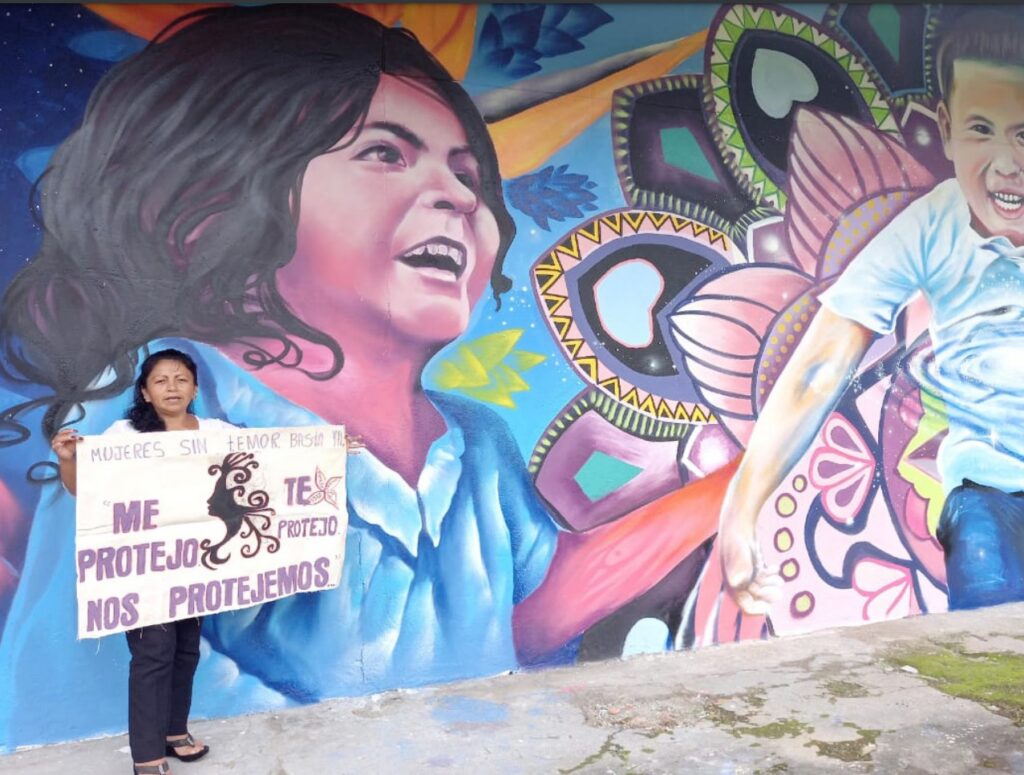
Image: A woman from ACTE holds a sign that says: “I take care of myself, I take care of you, we take care of each other.” © Jeffrey Duvan Acuña Mendoza