


20 December 2022
By Sanne Weber
In countries affected by conflict or authoritarianism, the security forces themselves can represent a threat to democracy and human rights.
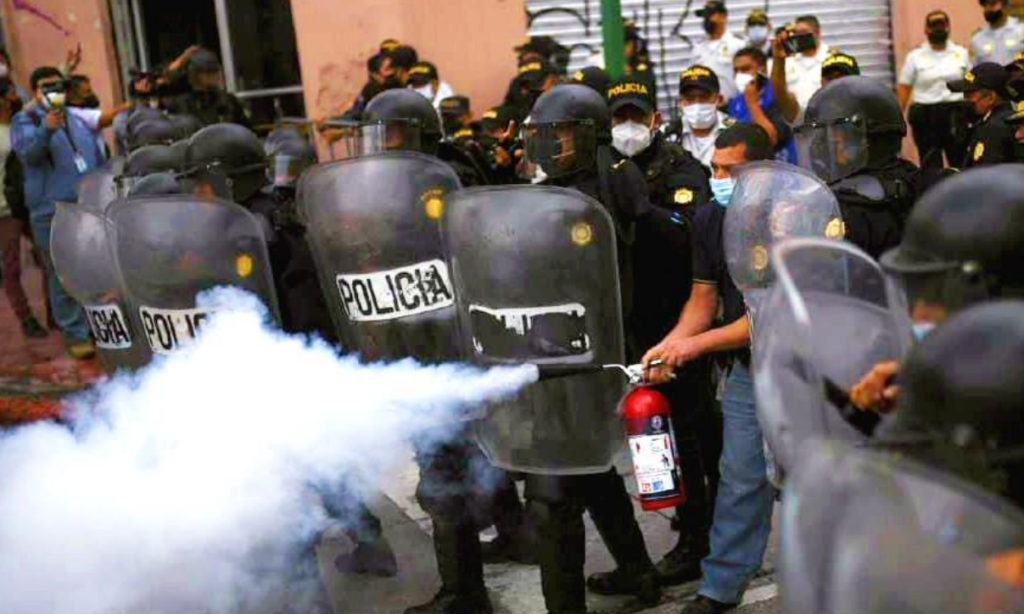
A new report by Impunity Watch shows how the process of increasing militarisation of the Guatemalan National Civil Police implies risks for the security of women and non-heterosexual men within the police and society at large.
It also presents an obstacle to combating impunity for human rights violations, particularly gendered violence.
What is ‘militarisation’?
In peaceful societies, police forces are meant to protect the civilian population and be the first resort in the case of crime or crises. They should have a civilian character but often become militarised in conflict situations.
Militarisation refers to a process in which military attitudes, practices and behaviours, which are common during conflict, become embedded and institutionalised in wider society and institutions, even when conflict has ended.
In Guatemala, the National Civil Police (PNC) was created as a result of the 1996 Peace Agreements. The PNC was meant to be a professional civilian police force which respected human rights, promoted democracy and with a gendered and multicultural perspective. Nevertheless, in recent years the PNC has become increasingly militarised.
This is displayed through the excessive use of violence as the main solution for problems; the use of threats, force, and a culture of fear to control the population; the dehumanisation of political enemies (often minorities, poor people or human rights defenders); extreme discipline; and a hierarchical structure where critical opinions are not welcomed.
Militarisation in the Guatemalan police starts from training where a greater emphasis is placed on physical, operational, and symbolic aspects of police work, often with a militarised character, than on human rights.
Militarisation is also evident from the growing military control over the police; the involvement of the PNC in serious human rights violations, crime and corruption; and the excessive use of force against the civilian population.
In this way, security forces are based on an exalted model of hegemonic masculinity which relies on violence and aggression to control others.
The problem with militarised masculinities
Despite the increase in women within the PNC, their position is fragile, and they are underrepresented in leadership positions. They often feel discriminated against or forced to adapt to masculine standards. The resulting gender inequality and norms of militarised masculinity lead to bullying and (sexual) harassment of women and homosexual men in the police.
Impacts on wider society are especially concerning, with sexual violence against civilian population committed in land evictions, police officers involved in human and sexual trafficking and a prostitution ring, and ineffective investigations into gender-based violence and femicide cases, thus increasing impunity. These tendencies have a detrimental effect on citizens’ and especially women’s feeling of safety.
Although security sector reform (SSR) is often included as a guarantee of non-repetition within transitional justice, masculinities are generally not part of the gendered perspective that is promoted in SSR processes. Instead, these tend to emphasize the integration of women into the security sector. Yet including a limited number of women, often in subordinate positions, is generally not enough.
Gender policies for police transformation
To create a police force that prevents violence and respects human rights, a different, less aggressive, and less militarised form of masculinity is needed. This requires implementing effective gender policies, aimed to protect both staff and the general population. In addition to integrating more women or addressing their needs, specific attention needs to be paid to the transformation of militarised masculinities and the of militarised practices that maintain them.
Read the report here.
Sanne Weber is Senior Programme Officer at Impunity Watch, focusing on gender.