


15 March 2023
As the Syria Truth and Justice Charter expands to 10 members, we look back at how Syrian victim associations have been advocating for action to clarify the fate of the missing in their country.
Enforced disappearance is not a new issue in Syria. The country has been ruled by an authoritarian regime for the past five decades, and many Syrians have gone missing.
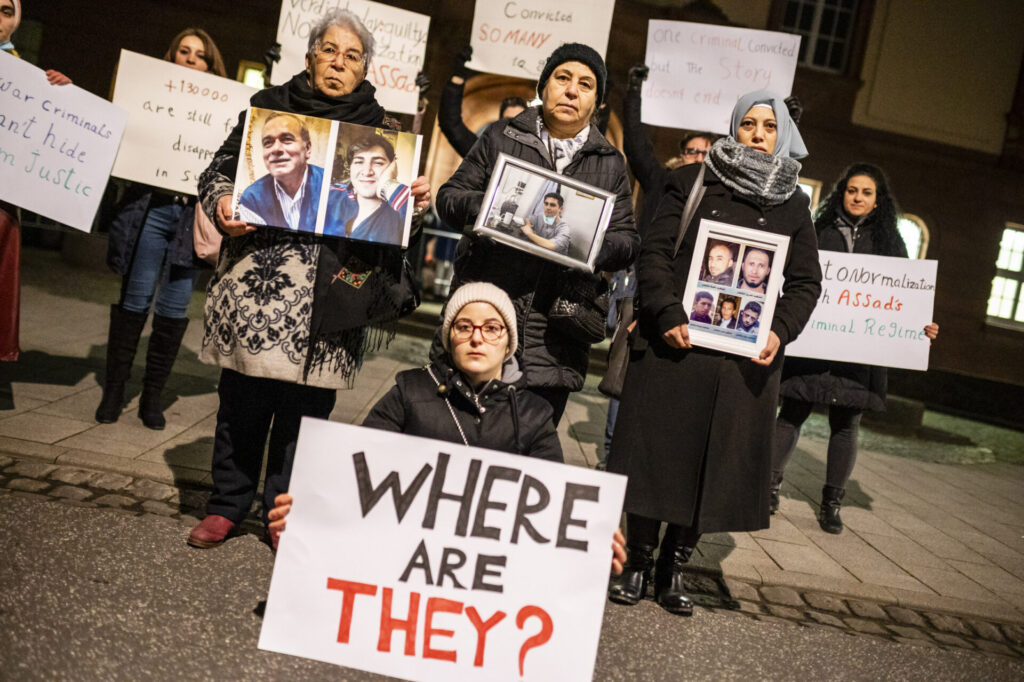
Since the beginning of the Syrian revolution and the conflict that followed in 2011, tens of thousands of people have gone missing in Syria, constituting a major humanitarian crisis. Moreover, Syrians continue to suffer from gross human rights violations on a large scale committed by the regime and other parties.
These include arbitrary detention, enforced disappearance and torture.
In the absence of a formal peace settlement, and despite China and Russia blocking the UN Security Council from referring the issue to the International Criminal Court, intensive advocacy efforts by Syrian civil society and victims’ associations have sought to push the justice and accountability agenda forward.
Within the context of fighting impunity in Syria, Syrian families of persons forcibly disappeared and survivors of detention have jointly worked and progressively become the leading force in the fight for justice and truth.
In February 2021, the Truth and Justice Charter was launched by the Association of Detainees and Missing Persons of Sednaya Prison, the Caesar Families Association, the Coalition of Families of Persons Kidnapped by ISIS (Massar), Families for Freedom, and the Ta’afi Initiative.
What is the Truth and Justice Charter?
The Charter represents the victims’ independent voices and their own initiative, presenting a common vision and framework on the question of enforced disappearance and arbitrary detention in Syria. Through the Charter, the victims’ associations emphasises their central role in any justice and accountability process. Impunity Watch has provided technical and strategic assistance and advice to the founding groups throughout the process leading to the production of the Charter as well as supported its signatory associations to produce a study that looked into effective mechanisms and processes to address the problem of the missing. Titled “Humans Not Numbers: The Case for an International Mechanism to Address the Detainees and Missing Crisis in Syria”, the study has been used to lobby international bodies and UN Member States to take action.
These victim-led efforts have significantly influenced the international agenda on the issue of the missing and helped enhance the centrality of the role of survivors and victims and their families in developing solutions.
The Truth and Justice Charter’s impact
Notably, a groundbreaking report by UN Secretary General (UNSG) António Guterres was published in August 2022, recommending the creation of a new international institution, through the UN General Assembly, to clarify the fate of the missing and support their families – a key demand of the Charter groups.
The UN General Assembly continued this momentum through a resolution welcoming the UNSG report and committing to further action on the missing in Syria.
In December 2022, the UNSG met with representatives of the Charter, expressed his admiration for their efforts and stressed the need for all arbitrarily detained Syrians to be released, and for the fate of the missing to be clarified. He also reiterated his call on Member States to consider establishing the new institution.
Days later, the Charter announced its expansion from five to 10 members. The new members, General Union of Internees and Detainees, Release Me, Hevdesti-Synergy Association for Victims, Adra Detainees Association and Families of Truth and Justice declared their adoption of the vision of the Truth and Justice Charter, as well as their commitment and pursuit for justice based on victim-centered approach in Syria.
The expansion presents an important step towards the goal of the Charter, which aims to be a reference point for all stakeholders, human rights organisations, policymakers and decision makers working on the issue.
To capitalise on the international momentum to address the fate of the missing, Impunity Watch will remain committed to providing assistance to Syria’s victims to enhance their capabilities and participation in justice efforts, while ensuring their autonomy and putting their voices and demands at the centre. As of now, the UN General Assembly is currently examining follow-up action to the UNSG report.
We’re also drawing lessons from the experience of the Syrian victims to support our work in other contexts. For example, we are highlighting the successful advocacy efforts of the Charter to inform future action on the issue of the missing in Iraq.
Read more about the Truth and Justice Charter here.
Read more about our work in Syria.
Photo credit: Paul Wagner for The Syria Campaign