


3 November 2026
By Jelena Vujanović, Impunity Watch. Jelena is a human rights practitioner whose work focuses on the fight against impunity, gender justice, and gender-transformative approaches in conflict-affected and transitional settings (SWANA, East Africa, and Western Balkans).
On 25 October 2026, nearly 70% of Serbians voted for change in the parliamentary elections, a historic turnout not seen since 2000. A grassroots movement led entirely by students toppled Aleksandar Vučić’s ruling party, which had been systematically normalising impunity for almost two decades.
During Vučić’s tenure, state institutions, the judiciary, and public media were systematically captured to shield political allies and ruling-party elites from legal accountability, with the United Nations raising alarm about shrinking civic space ahead of the elections.
Such tactics strategically bank on inducing hopelessness and inaction, making Serbia’s student resistance a vital case study in courage. It is also a powerful reminder of what collective action can achieve, because the overturn of the Vučić regime did not happen overnight. It was the result of two years of relentless, coordinated organising rooted in non-violent action.
Background: Two years of mobilisation by Serbian students
No one could have predicted that a collapse of a train station canopy in 2024 would have the power to reshape Serbia’s political landscape. For Vučić’s government, perhaps this was yet another blunder they felt they could wave away. But it turned out to be a catalyst, bringing to the foreground root causes behind such an incident.
Demands for the truth, justice and accountability for the train station tragedy went at best unmet, and at its worst, forcibly repressed – including arbitrary detentions for activists and protestors. A monitoring study of the public broadcaster’s flagship news show found five months without a single critical moment about the president during this period.
Corruption, institutional capture and the absence of accountability can create a sense of powerlessness, but they can also trigger collective resistance. Serbia demonstrates how public frustration with impunity can become a powerful force for democratic change.
Students have led this mobilisation, which is evidence that a new generation is no longer willing to accept injustice and authoritarian practices as inevitable. Their courage and determination have helped restore a sense of collective agency and political possibility. Despite no backing from established political parties or “charismatic” leaders, the student movement in Serbia held fast. Decisions were made through student plenums and, later, citizens’ assemblies organised by residents themselves. They engaged in creative forms of non-violent resistance, from music and art to sport – effectively bringing together different generations and cross-sections of society, from farmers to teachers, to sustain momentum.
Powerful foreign allies sought to trip them up at every turn, branding them a foreign-funded coup attempt. Against all these odds, they successfully mobilised their demands: a transparent investigation, then an early election, alongside an end to corruption and a free press. They rallied to motivate previously passive citizens to vote. On election day, long queues formed at polling stations in Serbia and in cities around the world, as the diaspora joined in.
The change was immediate and electric. The day after the election, the anchor of Radio Television of Vojvodina’s evening news apologised on air, saying the public broadcaster had for years failed in its function, withheld stories and reported uncritically. Staff at Serbia’s national broadcaster, RTS, are now demanding that its leadership resign.
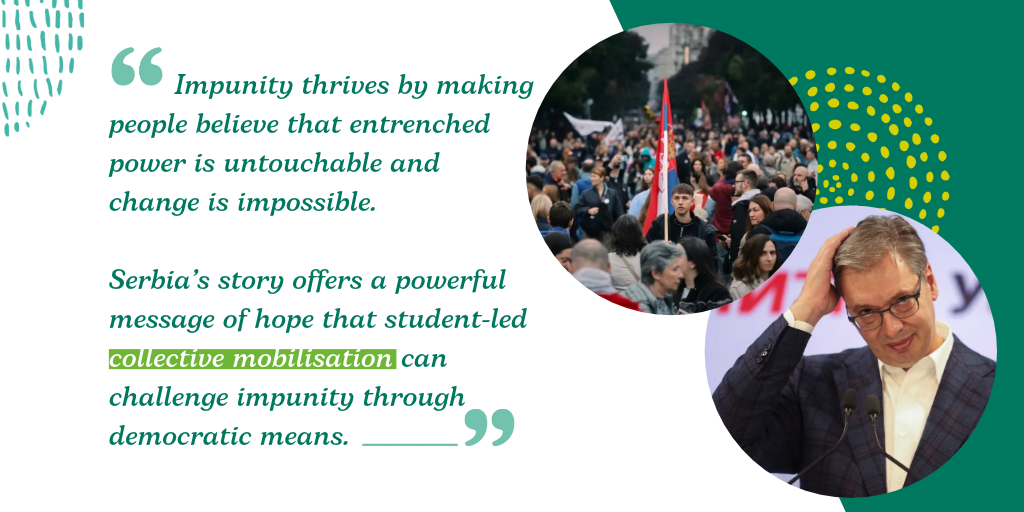
Impunity thrives by making people believe that entrenched power is untouchable and change is impossible. At a time of growing authoritarianism and democratic regression, Serbia’s story offers a powerful message of hope that collective mobilisation and endurance can challenge impunity through democratic means.
What’s next for youth-led movements in Serbia?
- Democratic movements in the Western Balkans can share lessons
Serbia’s experience carries a message of hope far beyond its borders, that authoritarianism and impunity are not inevitable or irreversible in the wider region. At a time when authoritarian forces are learning from and reinforcing one another, youth-led and democratic movements must also draw strength, inspiration and solidarity from each other’s struggles as a key to breaking cycles of impunity.
In April, Hungary’s voters ended Viktor Orbán’s 16-year rule. Bosnia saw street protests in March after a tram derailment killed a 23-year-old. In Albania, youth-led protests that began in May have escalated since mid-October in demands for Prime Minister Edi Rama’s resignation, and analysts describe a decentralised, youth-driven movement.
Young people and civic movements continue to challenge corruption, institutional capture and entrenched political power, and there is enormous potential for such movements to exchange experiences, learn from one another and strengthen regional solidarity.
- Dealing with the past is essential to building a democratic future
Serbian political leaders have long instrumentalised the past to fuel nationalism, deepen divisions and consolidate political power. A new democratic alternative must break with this practice rather than reproduce it. There must be no false choice between fighting corruption today and ensuring accountability for war crimes and past atrocities – both forms of impunity must be challenged.
Confronting the past, centering victims, and promoting accountability are essential to breaking cycles of impunity and to tackle the unresolved legacy of war crimes, nationalism, and historical revisionism.
- The importance of solidarity and the EU’s role
Challenging entrenched power is only the beginning. Turning democratic momentum into lasting change requires building credible alternatives, strengthening accountable institutions and sustaining strong civic ecosystems. Backlash from those benefiting from impunity is to be expected, making long-term solidarity and strategies to protect democratic gains essential.
Civil society must remain independent, even after democratic change. Challenging those in power is one thing, but ensuring that the same practices are not reproduced is another. Independent civil society, journalists, student organisations and grassroots movements will remain essential in holding future governments accountable. The real challenge is not simply changing political leadership, but ensuring that the democratic energy that made change possible continues to shape institutions and political life.
The EU has a particularly important responsibility to stand firmly behind democratic forces, support civil society and independent institutions, and consistently uphold democratic principles and accountability rather than prioritising short-term political stability. It appears they have indeed been listening: Enlargement Commissioner Marta Kos said a new chapter can begin and that the EU door is open, and Commission President Ursula von der Leyen offered support on the rule of law, media freedom and fighting corruption. But a movement’s survival should not depend on one institution’s goodwill alone.
Most importantly, the movement will need help when confronted with external agendas and entrenched interests. From Russia’s influence, to regional issues around Kosovo and Bosnia and Herzegovina, and even Israel’s political and security relationships with Serbia; these may all be pressure points that challenge democratic transformation efforts to claim back a captured justice apparatus. We at Impunity Watch stand ready to support with our comparative experience.
*
Those that maintain impunity want us to believe it is inevitable, and unassailable. Serbia’s students have just offered the proof that it is not. The task now is to make sure they do not stand alone, and to continue the work of documenting resistance.