


3 November 2026
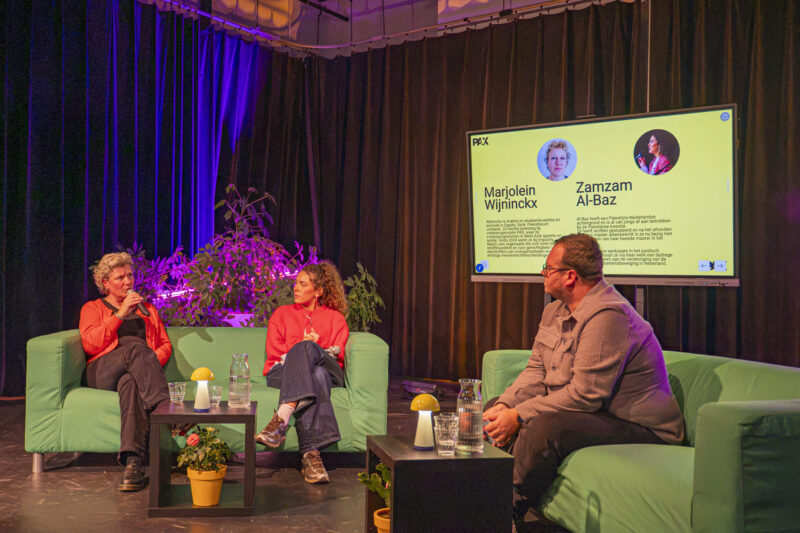
This week, Impunity Watch’s Marjolein Wijninckx participated in a discussion launching the photo exhibition by PAX, “Eyewitnesses: living with impunity”, demonstrating the daily reality of Palestinians in the West Bank and Gaza and centred Palestinian activists’ voices. Marjolein has studied, worked and lived in the WANA region since the 1990s and led peacebuilding, transitional justice and human rights programmes there. The piece below highlights her reflections on countering Israeli impunity.
The devastating consequences of impunity in Palestine
More than one year after the United Nations decisively concluded that Israel is committing genocide in Gaza, Israel continues to commit war crimes, crimes against humanity and the crime of genocide – while little to no action is taken to end these atrocities or its illegal occupation of Palestine. Meanwhile, the Dutch government continues to provide funding and facilitation, from arms trade and military cooperation to “business as usual,” – only recently have there finally been sanctions placed on trade with unlawful Israeli settlements, which were already direct violations of international law. The red line against Israeli impunity has been crossed long ago.
Impunity is a political choice made by power holders to tolerate or enable violations without fear of consequences. Unequal power relations, historical abuses, authoritarian governance, failed international interventions and institutions captured by corrupt or complicit elites altogether sustain that choice – lowering the political, legal and moral cost of wrongdoing.
Impunity in Palestine started with the colonisation of the land and the Nakba of 1948, when hundreds of thousands of Palestinians were forcibly displaced and dispossessed. Before the genocide that followed 7 October, roughly 70% of Gaza’s population were refugees or their descendants, the families of those displaced in 1948.


The genocide in Gaza and current violence in the West Bank must not only be seen to the background of decades of impunity for Israel, but also against a sharp rise in impunity internationally over the past 10 – 15 years:
- The period from the chemical attacks in Syria in 2013, when Obama did not stick to his self-declared “red line”
- The Russian annexation of Crimea in 2014 which was met by international accommodation
- The coordinated genocide of the Muslim Rohingya minority around 2016-2017 by Myanmar armed forces
Each time, governments committing atrocities learned they had a green light to perpetrate them. International norms were grievously undermined by a lack of action by international actors.
The use of starvation as a weapon of war also became widespread in that period. During the war in Syria, an estimated one million people were held under siege. The Netherlands supported the development of UN Security Council resolution 2417, unanimously adopted in 2018, which strongly condemns the use of starvation as a method of warfare. Starvation was also explicitly added to the Rome Statute and the Netherlands added starvation to its International Crimes Law. However, this came with little enforcement and follow up from the Netherlands. In Gaza, we saw the use of starvation at an even much larger scale, where the whole population of over 2 million people were held under siege and starved.
A legal order eroding, but in need of urgent defense
Over the past years, the universal human rights norms and architecture have eroded, and that erosion painfully shapes the international response to Gaza. Resisting that erosion means protecting institutions such as the International Criminal Court, including its arrest warrants, whose loss would be enormous. It also means defending the International Court of Justice and the special procedures of the Human Rights Council. At a time when these institutions are placed under intensive pressure, independent monitoring and fact-finding are more important than ever for the pursuit of accountability. We must defend this order and also reform it, so that it can act more equitably, fairly and meaningfully. Impunity Watch is, for example, part of a coalition of European organisations that work with victims to fight impunity that advocates for the protection of the ICC. Recent gains in Serbia further offer a reminder and hope of what is possible: institutions captured for decades are not beyond challenge, while strategic mobilisation coupled with civil society pressure can result in meaningful systemic change.


“If we really want change, we should not wait for our governments. We have to take action ourselves.” – Palestinian legal expert, Zamzam al-Baz
The resistance to impunity requires cooperation and building inclusive movements, with a whole ecosystem of different actors playing complementary roles. Victims of atrocities, as rights holders, play a leading role and need support from civil society, international institutions, lawyers, media and the public at large. A resistance ecosystem must also be inclusive and recognise the courage of those who speak up against the architecture of impunity. This includes those inside Israel who oppose genocide and ongoing occupation, often at real cost.
The “red line” has been crossed long ago – take action with us
Impunity Watch is one of 150+ civil society organisations supporting the Red Line protest, happening on 8 November 2026. As the genocide against Palestinians continues, and Israel persists in its attacks, occupation, and killings, we must ramp up our actions until the Netherlands implements firm measures to pressure Israel to stop the genocide and other crimes and end the illegal occupation of Palestine in line with the International Court of Justice’s ruling. The Netherlands must fully commit to accountability for crimes committed under international law, whoever the perpetrator, including support for and protection of international courts in The Hague.
The Red Line protest is an important opportunity to show the Dutch government that international law is a red line for us, that we expect the government to do what is within its power to stop the genocide, and we do not accept complicity of our government in war crimes (for example, cooperation with the Israeli defense industry).
The flow of funds fueling this genocide and illegal occupation must be shut off. Learn more about the collective demands and march together with us in Amsterdam (Museumplein) at the Red Line protest on 8 November 2026, from 13:00. Join us.
Experience the photo exhibition by PAX, “Eyewitnesses: living with impunity”, demonstrating the daily reality of Palestinians in the West Bank and Gaza. It is available to visit for free at Shopping Centre De Loper in Vlaardingen from 2–30 November, 2026.