


15 June 2026
Youth and women are often leaders in the fight against impunity. Yet, when it comes time to advance justice processes, they continue to be superficially consulted rather than centred as architects of accountability for atrocities that impact them the most.
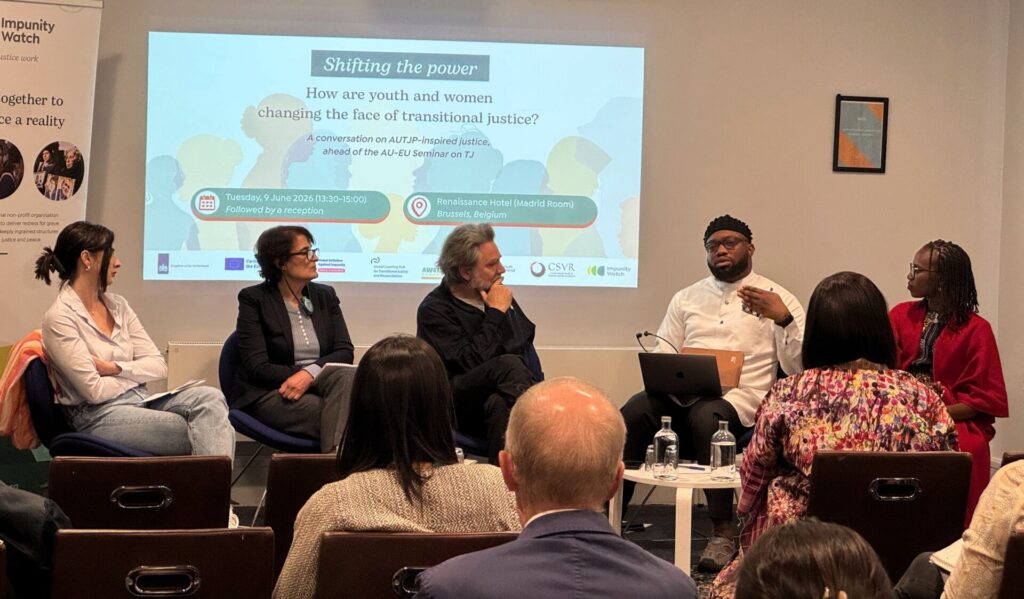
On 9 June 2026, ahead of the AU-EU Seminar on Transitional Justice (TJ) in Brussels, we brought together representatives of civil society, policymakers, researchers, diplomats, and practitioners for a pre-event to examine how transitional justice can be genuinely transformative.
“This pre-event has a single animating question: what does it mean to actually shift power? Not to invite more people to the table; not to add a youth panel or a gender chapter to a report; but to genuinely transform the power to define what justice means, who leads the process, and what accountability looks like in practice.” –David Taylor, Head of Africa Regional Programme at Impunity Watch
The discussion was inspired by our long-time engagement with the African Union, where we have been collaborating on the implementation of the African Union Transitional Justice Policy (AUTJP) at a regional and member state level. We work closely with youth and women’s platforms, and communities most affected by serious human rights violations to advocate for the representation of their policy needs, and link this to our engagements within the broader transitional justice system.
Beyond basic inclusion: Challenging power dynamics
Since its adoption in 2019, the AUTJP provides a comprehensive framework to address past injustices and promote sustainable peace across the continent.
While it remains one of the most ambitious and progressive transitional justice frameworks globally, significant gaps remain between its vision and the realities of implementation. Women and young people’s perspectives are often sidelined when it comes to decision-making power. Structural inequalities that contributed to violence often remain intact, even when transitional justice processes are formally completed, risking the recurrence of violence.
Opening the panel discussion, moderator Thomas Unger, Director of Policy and Research at Impunity Watch, reflected on the evolution of transitional justice. While the field is often associated with its four traditional pillars—truth, justice, reparations, and guarantees of non-recurrence—he argued that today, transitional justice must go further to address the root causes of violence, tackling existing hierarchies of power and inequality that enable impunity.
“[TJ today] is a contestation of principles and power – and an opportunity we should not waste.” –Thomas Unger
Across the discussion, panellists highlighted that shifting power requires moving beyond tokenistic inclusion of youth and women, towards influence and leadership.
Gender transformation requires challenging patriarchy
A central theme throughout was the need to move beyond narrow understandings of gender within transitional justice.
Christella Niyonimza, Impunity Watch’s Burundi Programme Manager, challenged the tendency of transitional justice processes to equate gender justice solely with responses to sexual and gender-based violence. While addressing such violations remains essential, she argued that transformative approaches must begin by examining the gender dynamics that existed before conflict erupted and that continue to shape societies afterwards.
This requires asking difficult questions. Which gender identities were privileged or marginalised? How did patriarchal structures contribute to violence? How do transitional justice processes themselves reproduce unequal power relations?

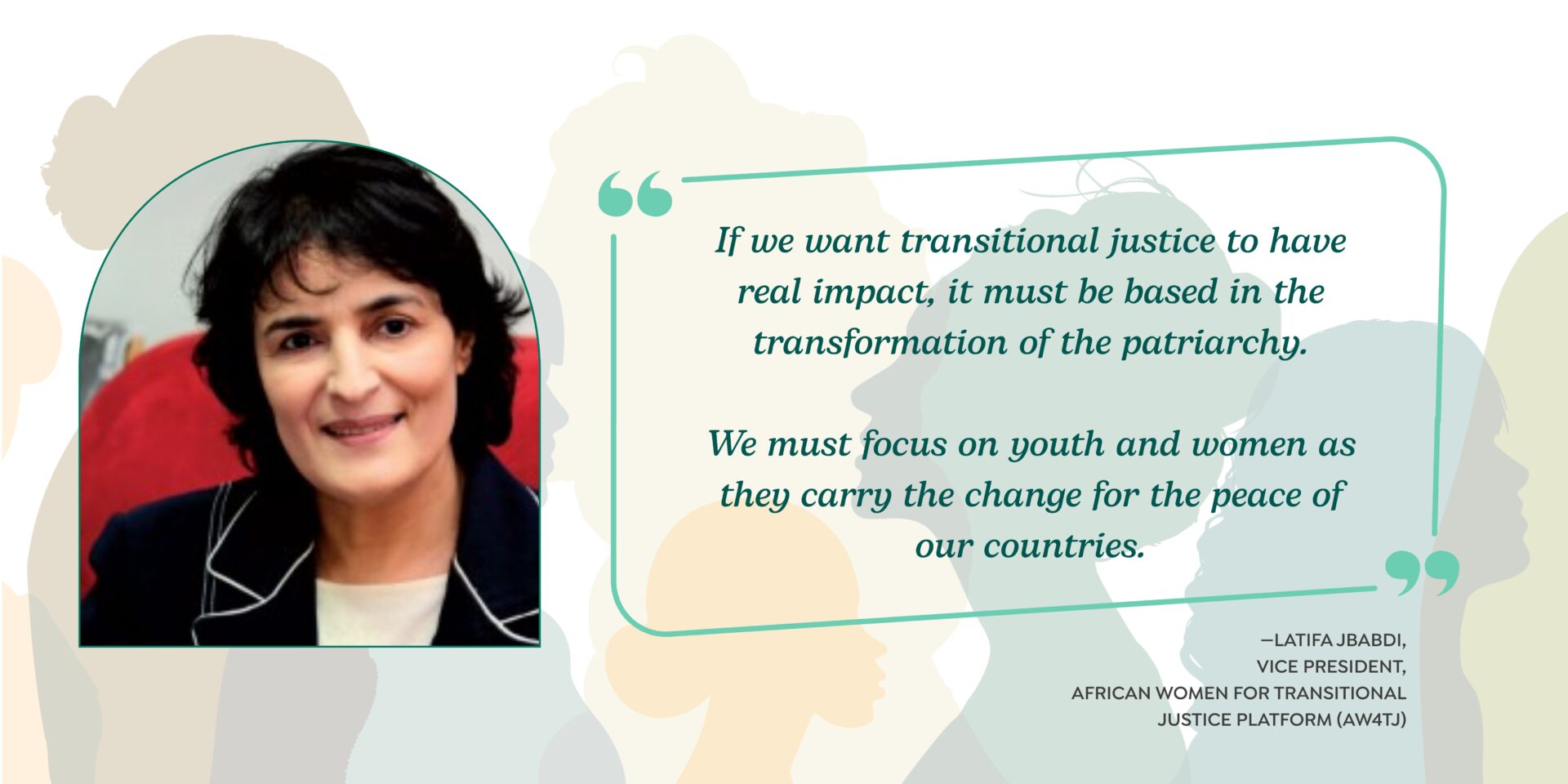
Vice President of the African Women for Transitional Justice (AW4TJ) Platform, Latifa Jbabdi echoed this point, arguing that patriarchal structures operate at the socio-cultural and political levels, institutionalising inequalities that exacerbate violence and sustain impunity. Gender transformation, participants agreed, must involve recognition, redistribution of power, and meaningful representation.
Latifa further raised the alarm that escalating geopolitical violence and the weakening of human rights values is only worsening the impacts of recurring conflict felt by women worldwide, not only on the African continent but also in places like Gaza. Addressing only the symptoms of violence is insufficient. Sustainable peace requires confronting the structural inequalities that make violence possible in the first place.
Youth participation: From symbolic representation to structural influence
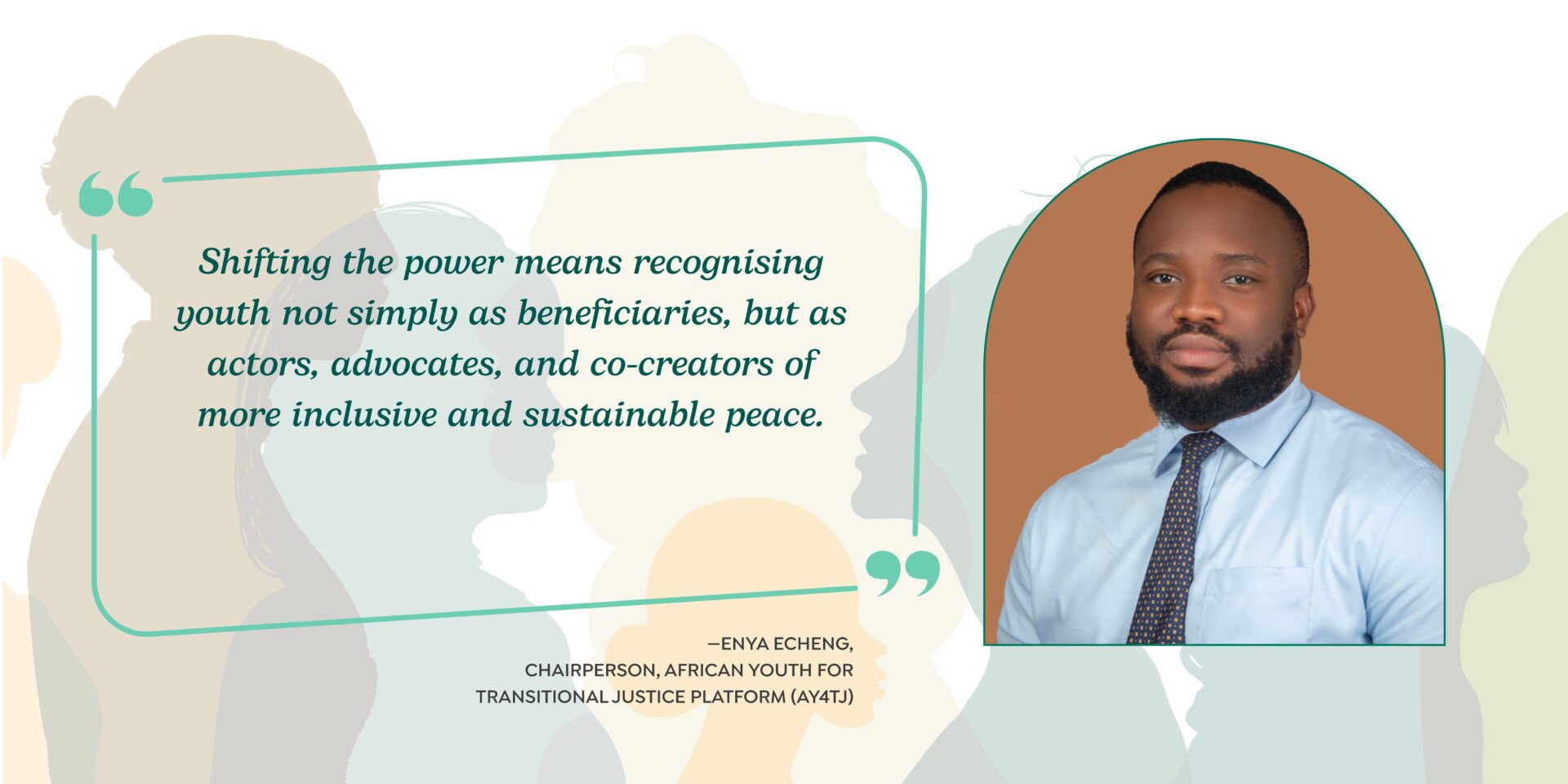
The discussion also examined the position of young people within transitional justice. When asked whether youth participation is a reality yet in Africa, Enya Echeng, Chairperson of the African Youth for Transitional Justice Platform (AY4TJ), acknowledged that important progress has been made. Platforms such as AY4TJ emerged precisely because of growing recognition that young people have distinct experiences, demands, and contributions to make within transitional justice.
For example, many youth reported that the AUTJP’s heavy structure and technical language limited their understanding, participation, influence on, and ownership of TJ processes. To counter this, we developed a joint resource – an accessible, inclusive version of the AUTJP that supports meaningful dialogue and engagement.
Explore the youth-friendly AUTJP resource.
Yet, political will remains a major concern. Young people are frequently offered symbolic representation without meaningful authority to shape outcomes. As Enya observed, shifting from progress to tangible change requires the structural implementation of youth agendas, and challenging exclusionary, ageist concepts of what counts as knowledge. He highlighted positive examples such as The Gambia’s National Youth Policy, which creates formal mechanisms for youth engagement.
Lessons from the Western Balkans on TJ and democracy
Drawing on experiences from Serbia and the wider Western Balkans, Sofija Todorović, Director of the Youth Initiative for Human Rights, highlighted the enduring challenges of dealing with legacies of past violence.
She warned that genocide denial and historical revisionism have increasingly re-entered mainstream political discourse in parts of the region, demonstrating both the possibilities and limitations of formal accountability mechanisms. Trials and legal judgments matter, but they are not sufficient on their own to challenge structural impunity.
Sofija argued that transitional justice must be integrated with broader democratic processes. Societies must actively cultivate historical understanding, civic engagement, and resistance to authoritarianism. Young people play a particularly important role in this regard, both as targets of political manipulation and as potential agents of democratic renewal.

Transitional justice is not a one-time intervention, but an ongoing social and political project comprised of diverse formal and non-formal mechanisms to transform societies. As the panellists noted, security cannot be achieved without addressing the past and ensuring that people feel protected by institutions and systems of justice. At the same time, memorialisation (such as this photobook project from Burundi), education, and community-based approaches remain essential for delivering justice and for sustaining progress over time.
Addressing historic injustices, reclaiming power
Questions from participants pushed the conversation into broader debates around coloniality, knowledge production, and global power relations. Several speakers reflected on the Eurocentric and academic influence on the interpretation of transitional justice, while noting its considerable evolution in practice. AUTJP-inspired policies and mechanisms should be equally valued as contributions to understanding justice and accountability.
To bridge similar gaps, we collaborated on a series of youth-led policy briefs that explore the linkages between historical injustices and their enduring impacts on young generations today. Their accompanying policy recommendations – such as designing transformative reparations programmes –have been well-received and taken up by the African Union, anchoring policy discussions in the voices, leadership, and vision of African youth.
Explore the Legacy series.
Re-interpreting the role TJ can play to address historic injustices, and ensuring that Global South experiences are equally valued, is an important call for action. Part of this is an increasing ownership and responsibility of the field by African actors and institutions. The challenge now is ensuring that local knowledge, lived experiences, and victims’ rights and priorities genuinely shape policy and practice, with adequate oversight to make sure that policies become meaningful. Ultimately, what counts is that victims receive justice and accountability in order to build more just societies for the future.
Shifting power, therefore, means rethinking our approaches to participation and representation. At its heart is the support for a justice ecosystem that is strengthened to fight impunity and address the root causes of ongoing serious rights violations. Redoubling efforts to support participation includes very practical interventions, such as removing material obstacles and practical barriers to participation – visa restrictions, childcare responsibilities, language barriers, and unequal access to resources.
What should the AU-EU partnership do differently?
We wrapped with a reflection on what the AU-EU partnership could do to better ‘shift the power’ in transitional justice. While the two TJ policies aren’t directly comparable – the former is ‘internal’ guidance for AU member states, while the latter is a foreign policy tool with significant challenges as outlined in our joint statement – there are nevertheless clear paths forward for more meaningful engagement.
Four key priorities emerged:
- Sustained political commitment, alongside technical and financial support.
Transitional justice initiatives require long-term investment and political commitment rather than short project cycles.
The EU and its Member States have substantial influence, and must step up to continue calling for an end to impunity both within and outside its borders.
The AU and its Member States must live up to their political commitment and ensure meaningful and effective implementation of the AUTJP. - Directly resource youth-led and informal TJ processes.
Community-based and youth-led initiatives must be recognised as legitimate pathways for accountability and social transformation – not as supplements, but together with formal mechanisms. Youth are crucial influences for the socio-political changes necessary to tackle systemic impunity and build a resistance ecosystem. - Women and youth must be seen as architects of accountability.
This means not only increasing their representation in policy and practice of TJ, but supporting them as:
Advocates in challenging inequalities shaped by patriarchy; and as
Drivers of policies based on the diverse roles they take in conflict-affected settings and in aiming to redistribute socio-economic and political power. - Stronger accountability within the AU-EU partnership itself.
The AUTJP already provides a robust framework, but the challenge lies in ensuring that funding mechanisms and institutional practices align with its transformative ambitions. TJ plays an important role in recognising victims’ rights, but this role must be advanced within broader development, governance, and peacebuilding agendas.
“Justice cannot be separated from the social and economic conditions that shape people’s everyday lives.”
As Annah Moyo of the Centre for the Study of Violence and Reconciliation (CSVR) noted in her closing reflections, transitional justice is inherently political and has a specific role to play in addressing the socio-economic conditions that are root causes for serious human rights violations. The best hope for lasting transformation and dismantling entrenched power structures is enabling women and youth to turn consultation into influence, and participation into leadership.
Impunity Watch’s work as part of a broader justice ecosystem will over the coming years prioritise just that – supporting the political mobilisation of African youth around transitional justice in the fight against impunity.
We thank our co-organisers, the Centre for the Study of Violence and Reconciliation (CSVR), the African Women for Transitional Justice Platform (AW4TJ), and the African Youth for Transitional Justice Platform (AY4TJ), in collaboration with the Transitional Justice Unit of the African Union’s Political Affairs, Peace and Security Department (AU DPAPS) for all the support in organising this event.