


19 May 2025
Update: On 30 May, the three former paramilitaries were sentenced to 40 years each in prison after being found guilty.
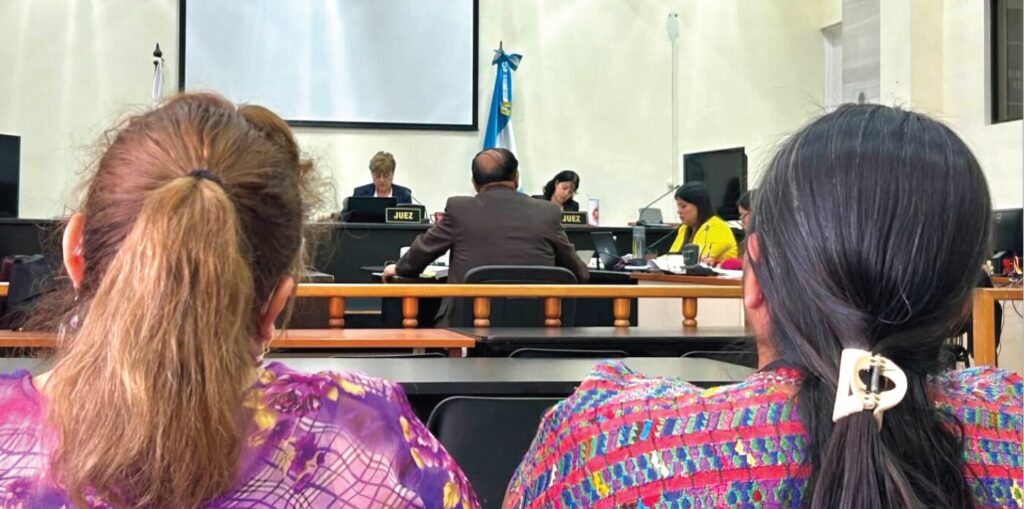
The second trial in the Achi Women’s Case is about to end. After four months of hearings, on 30 May, the High-Risk Court B will issue a verdict against three former members of the Civil Self-Defence Patrols (PAC, in Spanish), Pedro Sánchez Cortez, Simeón Enríquez Gómez, and Félix Tum Ramírez.
They are accused of sexual violence and crimes against humanity committed against six Maya Achi women from the municipality of Rabinal, Baja Verapaz, between 1981 and 1983 during the internal armed conflict in Guatemala.
This case was initiated with a complaint filed by 36 victims between 2011 and 2015 against former soldiers, military commissioners, and paramilitary (PAC) members for sexual violence. As a result, in January 2022, the first trial was held against five former paramilitaries who were convicted to 30 years in prison for these acts. Throughout all these years, the victims have had the support of the Association of the Rabinal Popular Legal Office (ABJP).
The Achi women have been waiting for justice for over 40 years. In the 1980s, they were systematically raped by paramilitaries and soldiers in their homes and in military bases.
They were arbitrarily detained for several days in military facilities, where they were tortured and raped. Several of their family members were disappeared or killed by former military or paramilitaries, and they also lost their homes, animals, and belongings.
“I am hoping for justice and that [the paramilitaries] stay in prison”, stated Paulina Ixpatá during her testimony.
She emphasized that it was not only the sexual violence they endured— their family members were also killed, their animals stolen, and their homes were burned. In this second trial, the victims hope the court will impose a sentence similar to the one in the first trial.
This case is significant because it highlights how the Guatemalan army used sexual violence as a weapon of war against indigenous women during the armed conflict. This pattern is documented in the truth commission report (CEH) and has been confirmed in the verdicts of previous cases, including the Ixil Genocide (2013), Sepur Zarco (2016), and Achi Women (2022). Sexual violence was used by the army as a method to control, punish, and instil fear in indigenous communities, as well as to degrade the women and their descendants.
It is essential that, through this case, Guatemala reaffirms its commitment to prosecuting atrocity crimes, providing redress to victims of sexual violence and indigenous communities for the harm suffered, and implementing measures to prevent recurrence.
Read more in Impunity Watch’s bulletin:
Spanish English