


12 September 2025
More than 45,000 people were forcibly disappeared during Guatemala’s internal armed conflict – most of them Mayan Indigenous people. Each forced disappearance leaves an open wound, a life in perpetual suspense, and a silenced truth.
The Inter-American Court of Human Rights (IACHR) put forth a ruling in November 2024 that holds the State of Guatemala accountable to the design, implementation, and enforcement of a national strategy, mechanism, or program to search for missing persons who were victims of forced disappearance, including those who disappeared in the context of the internal armed conflict. Such a plan would restore answers to the relatives of the disappeared, and be a step towards truth, justice, and memorialisation.

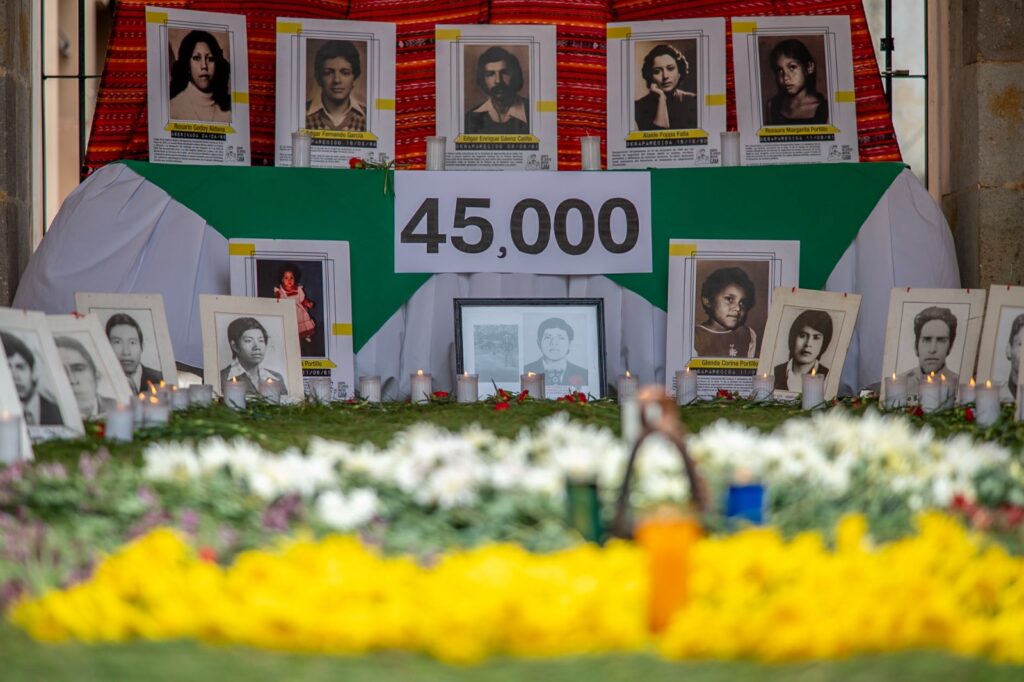
On 28 August, we took part in commemorating the International Day of the Victims of Enforced Disappearances, , together with the National Platform of Victims of the Armed Conflict and the Office of the United Nations High Commissioner for Human Rights (OHCHR). Survivors, relatives of victims, members of civil society, and authorities of the Government of Guatemala beginning with a Mayan invocation during which red carnations and white candles were placed in front of photographs of those who disappeared. The participants acknowledged the historical debt of the Guatemalan State to the families of the 45,000 people who disappeared during the armed conflict.
Together, we came together to understand the options for advancing the search for the missing, the expectations of victims, and the support and commitment at the international level. The forum “Paths for the Search of Victims of Enforced Disappearance”, included the participation of Elvyn Díaz, Director of the Presidential Commission for Peace and Human Rights (COPADEH); Feliciana Macario of the National Platform of Victims; and Juan Pablo Albán of the United Nations Committee on Enforced Disappearances. They reflected on the urgency for the government to approve the National Plan for the Search of Victims of Enforced Disappearance.
“We have spent decades searching for our missing loved ones, but no government has supported us. We hope that President Bernardo Arévalo fulfills his promise to create a National Search Plan.” –Feliciana Macario of the National Platform of Victims
Feliciana Macario recalled that her fight for truth and justice began after the disappearance of her older sister, Josefina, who was disappeared in the early 1980s and was never seen again. She reaffirmed that the families of the victims will not rest until they find their loved ones, because “the State still maintains a historical debt to our families.” She, like thousands of other families, calls on the State to take responsibility for the search for the disappeared.
Elvyn Díaz, the Executive Director of the Presidential Commission for Peace and Human Rights in Guatemala (COPADEH, in Spanish), indicated that the government is preparing a National Plan for the Search of Missing Persons, which must be submitted for consultation with victim organisations and the families of the disappeared, and be approved by President Bernardo Arévalo.

Juan Pablo Albán, Committee Rapporteur on Enforced Disappearances pointed out that the State of Guatemala must ratify the International Convention for the Protection of All Persons from Enforced Disappearance, as it is an instrument that provides greater protection to its citizens against this type of atrocity. He emphasized that with political will, the State can immediately implement a national search plan that responds to the families of the victims.
Finally, Mika Kanervavuori, representative of OHCHR in Guatemala, stated that he awaits the approval of the national search plan and reiterated that his office will continue supporting the efforts to create this plan, which is crucial for strengthening human rights and the rule of law in Guatemala.
We are still searching!
Since the signing of the peace agreement in 1996, Guatemala still lacks an official mechanism for the search or identification of victims of enforced disappearance. Search and exhumation initiatives have been carried out by civil society organisations, and to date, more than 10,000 skeletal remains have been found buried in clandestine cemeteries and military outposts.
International human rights bodies have indicated that the Guatemalan State must fulfill its obligations regarding the prevention and investigation of enforced disappearances, including ratifying international treaties and implementing search mechanisms.