


2 May 2024
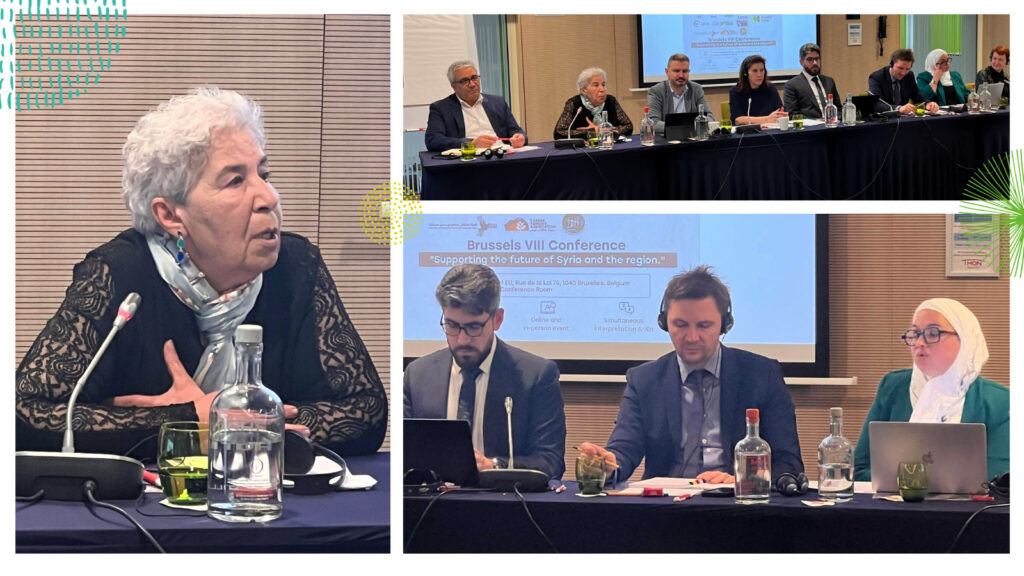
In partnership with Impunity Watch, the Truth and Justice Charter organised a side event at the eighth Brussels Conference on ‘Supporting the future of Syria and the region’. The panel discussed ongoing efforts to address the crisis of the missing in Syria, including the operationalisation of the the Independent Institution on Missing Persons in Syria (IIMP). We heard directly from Syrian victims, survivors, and families on their role in its work.
What is the Independent Institution on Missing Persons in Syria (IIMP)?
Since the start of the Syrian uprising, at least 100,000 people have gone missing. The crime of enforced disappearance has affected countless Syrians, unaware of the fate and whereabouts of their loved ones.
After years of tireless advocacy by families of victims and survivors, the UN General Assembly established the Independent Institution on Missing Persons in Syria (IIMP) in a historic resolution to:
- Clarify the fate and whereabouts of all missing persons in Syria; and
- Provide adequate support to victims, survivors and the families of those missing
The main tasks to determine the fate and whereabouts of missing persons in Syria will include: mapping relevant actors and establishing cooperation; establishing a registry of missing persons; and designing a comprehensive search plan, among others. An unprecedented element of the IIMP is its focus on victim participation.
“There can be no political transition in Syria unless the fate of the missing is clarified and the arbitrarily detained are released.” – Khalil al-Haj Saleh of Massar Families, one of the organisations in the Truth and Justice Charter
What do victims and survivors want from the IIMP?
During the panel, Khalil al-Haj Saleh proposed that once a case of missing persons is reported to the IIMP, a formal, legal document should be issued to reflect this and certify the disappearance. Such a document would provide families access through a robust referral system to crucial and diverse forms of support and services they may require (for example, access to education/ healthcare, immigration assistance, etc.). This would both alleviate the burden on the IIMP while enabling it to focus on the search for the missing.
While the IIMP is a significant milestone, victim groups warn that there is much work yet to be done to reach all victims and survivors. Fadwa Mahmoud from Families for Freedom (another member of the Truth and Justice Charter) emphasised that:
“If we want meaningful participation, there should be fairness and inclusion in the [process]… the IIMP must reach out to all survivors and victims. Yes, the IIMP is a hope for us – but all together, we should do our best to ensure this renewed hope is not a lost hope.”
International commitment to address Syria’s missing persons crisis
Anne Massagee, Head of the Transition Team at the IIMP renewed the Institution’s commitment to take into account the priorities of victims and survivors and the wider civil society and ensure their full participation. Responding to Fadwa’s point, she highlighted the potential for future field presence in countries with large Syrian populations in addition to the headquarters in Geneva.
As a representative of the Luxembourg Permanent Representation to the EU further highlighted:
“We are grateful to the Syrian families and victim groups for their tireless advocacy… [their] courage and resilience have been instrumental in the creation of this mechanism.”
Visualising the Syrian fight for freedom
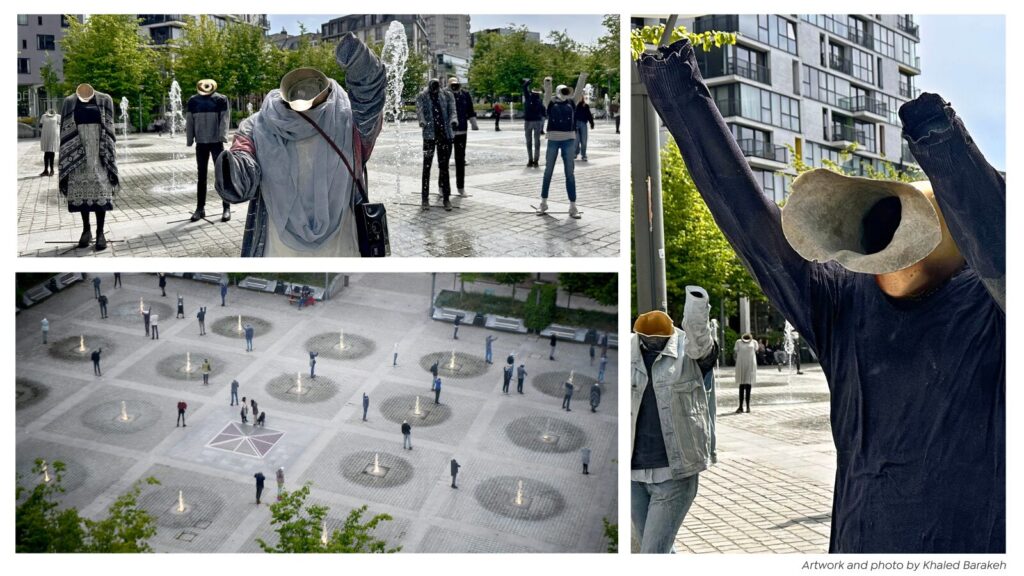
In parallel to the side-event, we also supported the public art installation MUTE in Place Jean Rey in Brussels, by Syrian artist Khaled Barakeh. It pays tribute to those who fight for freedom in Syria, and seek justice and accountability for the violations committed over the past 13 years. According to the artist:
“The power of art lies in its ability to allow personal stories and experiences to be told. As we gather to discuss the future of Syria, this artwork brings out memories, traumas, and anguish of Syrian victims. Despite the attempts to be repeatedly silenced, they continue to call for freedom, dignity, and justice for all victims and their families.” – Khaled Barakeh
Find out more about our work on Syria
This side event was co-sponsored by Belgium, Luxembourg and Switzerland.