


12 March 2024
In a poignant ceremony of remembrance, the first ever memorial dedicated solely to victims of enforced disappearances in Iraq opened on 4 March 2024.
The Memorial Garden, situated on a hill overlooking the Safina village and the Tigris river in southern Mosul, was spearheaded by victims, survivors and their families. It provides a much needed public space for local communities to come together, grieve and to advocate for accountability.
The memorial also carries forward the memories of disappeared persons and educates new generations about painful events in the history of their country.
Victim-led memorialisation
The memorialisation initiative was conceived and constructed by Al-Deerah, a local foundation composed of victims from the area whose family members disappeared during ISIS control (2014-2017).
Communities were at the forefront of the initiative. Local villagers donated land, while the municipality provided electricity and extended the road to the Garden.
The memorial thus serves as a physical testament to victims’ resilience, innovation, and ownership. It is also a permanent reminder of their continued demand for truth and justice.
A symbol of resilience
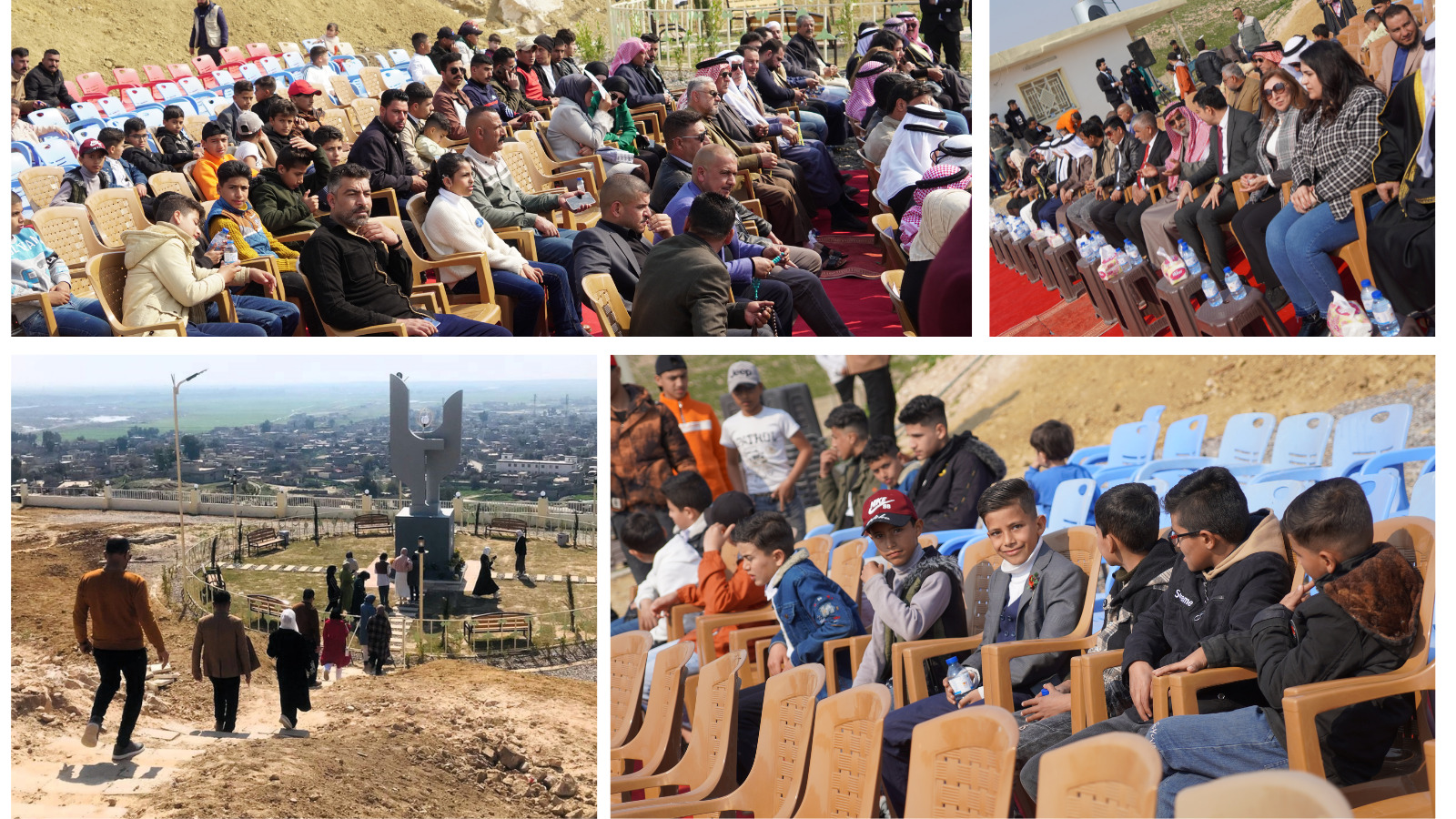
The Memorial Garden has a circular shape and four entrances, with a high monument in the centre. The design elements of the monument, including its distinctive shape resembling open hands reaching towards the sky, remind visitors of the toll of conflict and the resilience of the human spirit.
As visitors enter the garden, they are greeted by the inscription: Memorial Garden, established by Al-Deerah Foundation for cultural development and human rights to commemorate the tragedy of the missing persons and their families in southern Mosul.
Families and survivors from adjacent villages, as well as local leaders and partner organisations, attended the opening ceremony, including the symbolic cutting of a red ribbon around the monument.
Hazem Muhammad Ali, the leader of Safina village, expressed heartfelt solidarity with the families of the disappeared. He also emphasised the significance of collective remembrance in the healing process.
Hussein, a local resident and Master’s graduate in Law from Mosul University, said:
“The Memorial Garden means a lot to us as a symbol of moral support. We also want to send the message on the importance of financial support for the families of the victims, from soldiers to university professors and lecturers.”
Local resident Sajida, whose husband was abducted by ISIS, said:
“The memorial is a beautiful initiative… What’s most important now is for action to happen. The bodies of the disappeared abducted by ISIS must be found, and there must be more support for the families.”

Background and next steps
In southern Mosul, many villages such as Safina were the sites of brutal violence during the ISIS occupation between 2014-2017. Hundreds of residents, many of them Sunni men, were abducted, killed and presumed to lie in mass graves. These graves are yet to be exhumed, and the fate and whereabouts of the disappeared victims are still not known.
With up to one million people estimated to have disappeared in Iraq over the past half century – the highest number in the world – concerted political willingness and legislative reform is required to investigate allegations of enforced disappearance, bring the practice to an end, and ensure that victims enjoy their rights to truth and justice.
Impunity Watch is proud to have supported our partners in the construction of the Memorial Garden.
We aim to leverage the momentum of the memorial opening to advocate for truth and justice for the disappeared, and reconciliation on a national level. Through ongoing collaboration with local partners and our strong thematic focus on enforced disappearances, we’ll continue to support victim-led initiatives to pave the way for transformative justice.