


27 January 2025
Artificial intelligence (AI) is ubiquitous in society today. It is said to hold the promise of revolutionising scientific discovery, addressing climate change, and improving public services and human welfare in general. However, AI also poses significant risks, particularly in post-conflict contexts. These risks include the misuse of sensitive datasets, impacts on privacy and non-discrimination, and destabilisation of the information sphere, which may undermine truth-telling and justice processes.
In transitional justice settings, societies are confronted with a legacy of serious human rights violations and abuses, and are now also increasingly confronted with the impact of new AI technologies.
Building on its foundational work in this field, Impunity Watch (IW) has begun exploring the intersection of AI and TJ. Together with Dr Sue Anne Teo, a researcher on the Future of Human Rights project at the Raoul Wallenberg Institute of Human Rights and Humanitarian Law, we are pleased to present this overview report which maps and frames the connections between AI and transitional justice.
The report draws insights from an expert workshop conducted in partnership with the AI Futures Lab at TU-Delft. During this meeting, Dr. Bernard Duhaime, the Special Rapporteur on truth, justice, reparation and guarantees of non-recurrence emphasised that:
“It is crucial that victims of human rights violations be at the centre of our approach to understanding the implications of artificial intelligence for transitional justice.”
The report identifies the potential harms and emerging concerns in relation to how AI can impact the field of transitional justice and its victim-centred approach. At the same time, it examines AI’s positive role in transitional justice practices. It examines the intersection of AI and transitional justice through three interconnected facets: People, Practice, and Policy. This approach emphasises placing victims at the centre, evaluating the benefits and risks of AI in practical transitional justice contexts, and offering policy recommendations to address these challenges and opportunities.
*
Impunity Watch is one of eleven member organisations of the “Global Initiative Against Impunity for International Crimes and Serious Human Rights Violations: Making Justice Work.” This civil society-led initiative aims to combat the growing climate of impunity for core international crimes and serious human rights violations by promoting comprehensive justice and accountability. This report is one of several key activities of Impunity Watch within the Global Initiative and is co-funded by the European Union, and the Ministry of Foreign Affairs of the Netherlands.
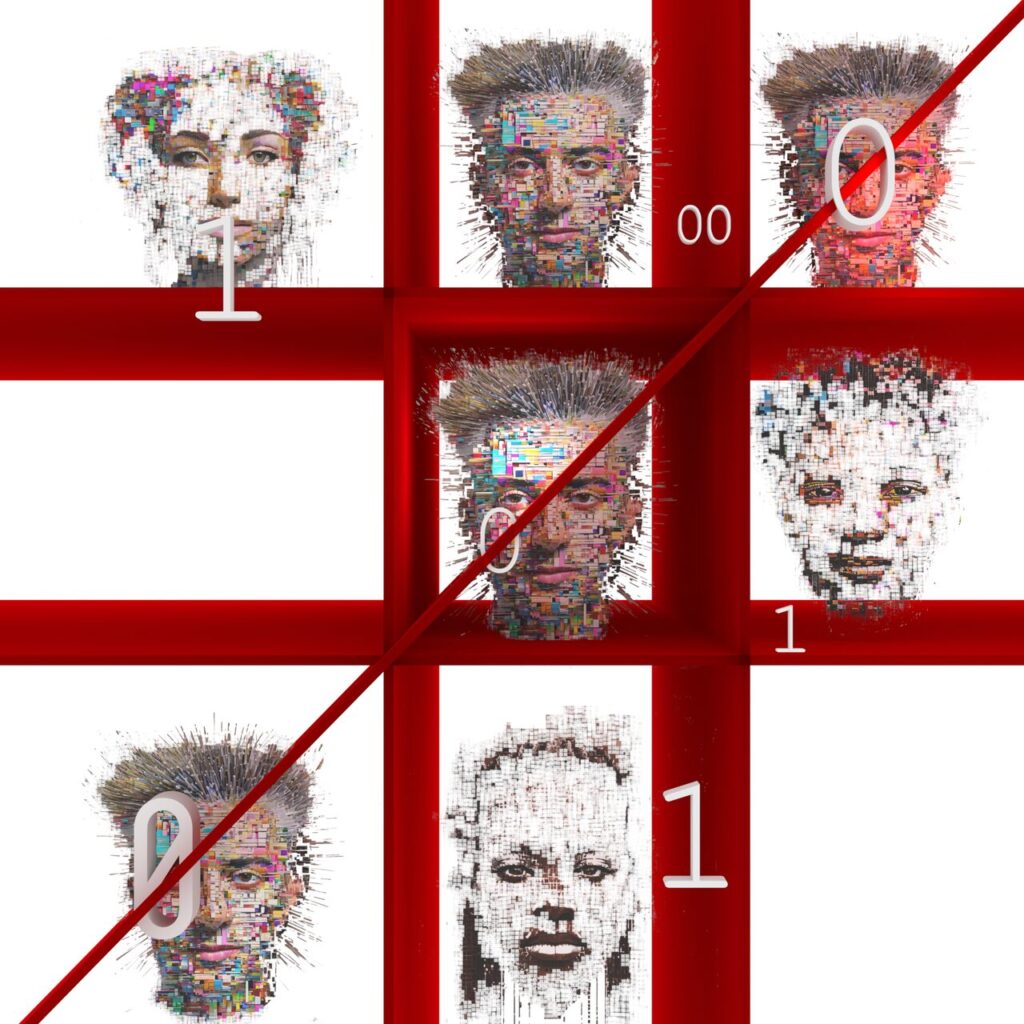
Cover Photo: A tic-tac-toe board with human faces as digital blocks, symbolizing how AI works on pre-existing, biased online data for information processing and decision-making. Amritha R Warrier & AI4Media / Better Images of AI/ tic tac toe/ CC-BY 4.0.