


18 November 2024
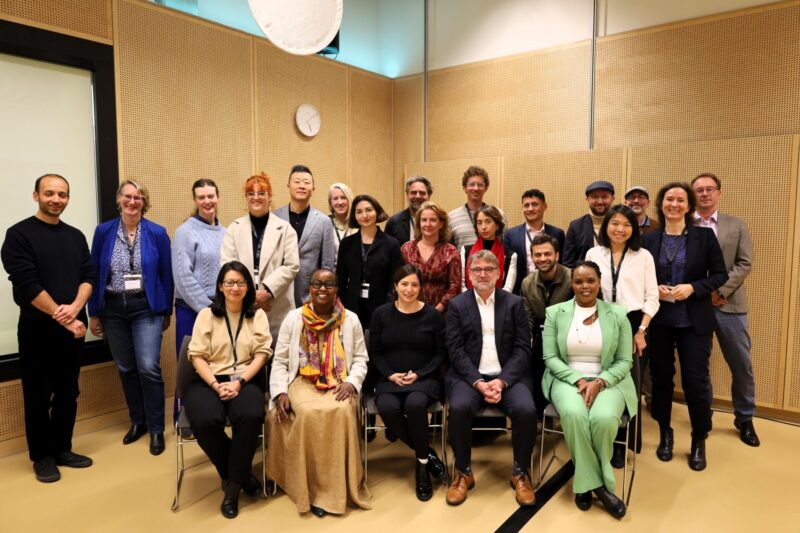
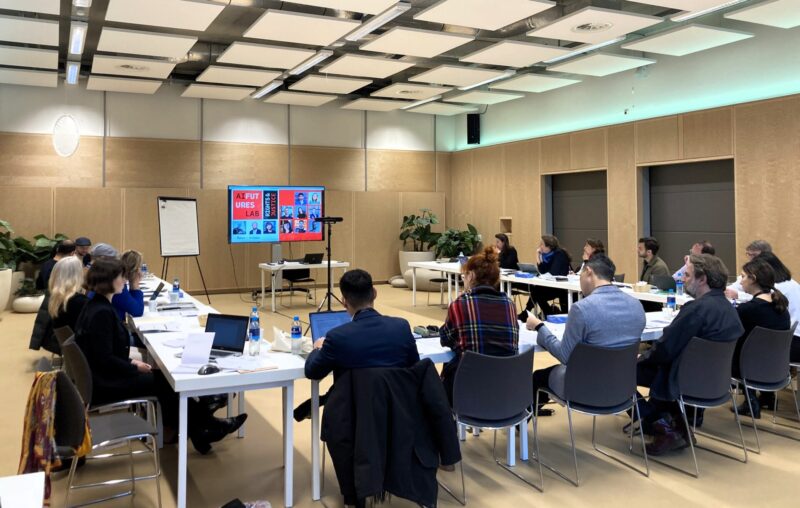
On Novermber 6, 2024, Impunity Watch and the AI Futures Lab at TU-Delft partnered to hold the first expert meeting exploring the intersection between artificial intelligence (AI) and transitional justice (TJ). A key question running throughout the one-day meeting was how AI can be leveraged to support a more victim-centred approach to justice.
The meeting highlighted the critical role AI could play in shaping a more just, accountable future where technology aligns with human rights standards in TJ contexts. It also noted that we are only at the beginning of exploring the link between AI and TJ from policy and practical application perspectives. Further interdisciplinary discussions and innovative thinking are needed to advance this field.
Bringing Together Experts Across Disciplines on AI and Transitional Justice
Participants were TJ and human rights practitioners, legal scholars in the field of international criminal and humanitarian law, AI designers as well as technology experts and scholars, and brought to the table a diverse range of expertise from transitional justice and human rights to digital evidence, AI governance, design ethics and the implications of algorithmic decision-making. They came from different institutions including the United Nations Office of the High Commissioner for Human Rights, The Harvard Humanitarian Initiative, TU Delft, Utrecht University, Columbia University, the University of Cambridge, the Council of Europe, the Raoul Wallenberg Institute of Human Rights and Humanitarian Law, the University of Quebec in Montreal, the International Criminal Court Trust Fund for Victims, the UN Independent Institution for Missing Persons in Syria and SAP. Notable NGOs were also present, including Mnemonic. The meeting was joined by Dr. Bernard Duhaime, the Special Rapporteur on truth, justice, reparation and guarantees of non-recurrence, who will focus one of his upcoming thematic reports on the topic of AI and TJ.
Exploring AI’s Potential in Justice and Accountability
The meeting’s main aim was to explore how AI could be harnessed to support TJ processes and make them more responsive to the needs and aspirations of victims of serious human rights violations, addressing both the opportunities and risks involved. The meeting introduced practical examples developed to promote accountability, preserve evidence, and support investigations. Examples included using sound patterns to identify bombings, leveraging open-source intelligence (OSINT) to track banned weapons like white phosphorus and gather evidence for war crimes prosecution, as well as processing existing TJ datasets to make them available for advocacy and research.
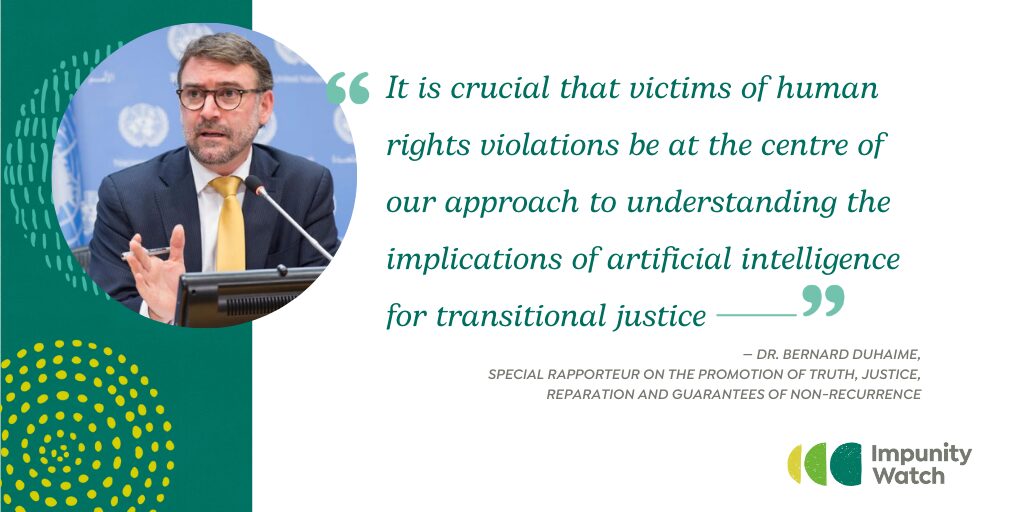
“It is crucial that victims of human rights violations be at the centre of our approach to understanding the implications of artificial intelligence for transitional justice. ” —Dr. Bernard Duhaime, the Special Rapporteur on truth, justice, reparation and guarantees of non-recurrence
Throughout the discussion, ethical considerations and potential harm to specific groups, if not properly regulated, were highlighted repeatedly. The meeting also explored how AI could contribute to operationalising broader notions of justice victims have repeatedly called for, such as the right to truth and the right to reparations. The lack of data on TJ, the highly fragmented nature of existing TJ datasets, and the evolving definition of TJ — which complicates the development of meaningful AI systems — were identified as major areas requiring further exploration. Furthermore, concerns about security breaches and the challenge of balancing the rapid advancement of AI with the long-term needs of TJ were highlighted.
Suggestions for the way forward included using smaller language models for AI applications to reduce risks of any backlash for victims, as well as finding ways to involve victims more systematically in pilot projects. Open questions remain regarding how AI can further contribute to reparations, truth-seeking, memorialisation and prevention without being a burden or marginalising victims and survivors, all of which require further discussion and development.
Addressing Risks, Ethics, and Systemic Safeguards
Another key topic of the discussions revolved around the potential challenges posed by AI to justice, including the detection of hidden biases and understanding the current regulatory systems such as the Council of Europe Framework Convention on Artificial Intelligence and human rights, democracy and the rule of law, EU’s AI Act and the Digital Services Act, as well as existing regulatory frameworks that apply to armed conflict and the potential use of AI therein.
Participants examined how standards and ethical guidelines could manage risks like disinformation, deep fakes, and general-purpose AI. They highlighted the need for AI systems to be designed in a transparent and human-centred manner that would ensure a meaningful role for humans in decision-making. This was considered particularly important in TJ contexts where trust is fragile and the social risks to victims and justice actors are high. AI frameworks that honour human dignity and promote responsible TJ initiatives, embrace interdisciplinary perspectives and adopt a victim-centred approach emerged as a central theme.
The role of businesses and the AI industry in ensuring such frameworks requires further discussions, especially regarding their conduct and responsibility as well as possible regulations that would be conducive to such frameworks.
Forging a Way Forward
There was consensus on the importance of interdisciplinary collaboration, bringing together academia, regulatory bodies, design and engineering professionals, and stakeholders in TJ, including victims and NGOs. In this regard, the expert meeting in Delft established a unique platform for further discussion on how to enhance the potential use of AI in TJ processes that can make a meaningful difference for victims.
Moving forward, an important step will be to develop a set of actionable recommendations and to further strengthen cooperation between AI and TJ actors. Such efforts should focus on practical, real-world applications within transitional justice mechanisms — such as criminal justice, reparations, truth-seeking, memorialisation and guarantees of non-recurrence — by bring together AI developers, TJ experts, and victims.
A key conclusion from the meeting was that there is an urgent need to establish clear guidelines to facilitate victim participation in the development of AI systems used in TJ contexts. This should include understandable principles for data use, measures to build the capacity of victims, the identification of specific entry points for victim involvement, and means for monitoring impact. Such foundational steps would help establish a framework to advance AI applications in TJ in a responsible and meaningful manner.
As part of its programme on AI and TJ, Impunity Watch has commissioned an overview paper to further clarify the link between AI and TJ. The paper is currently being drafted by Dr. Sue-Anne Teo, an expert in AI and human rights, and forms part of a partnership between Impunity Watch and the Raoul Wallenberg Institute of Human Rights and Humanitarian Law. Findings and recommendations from this expert meeting will contribute to the paper, which is set to be published later this year.
This meeting was made possible with support from the European Union and the Ministry of Foreign Affairs of the Netherlands.