


21 May 2026
Opinion piece by Marlies Stappers, Executive Director and Denis Martinez, Central America Office Coordinator
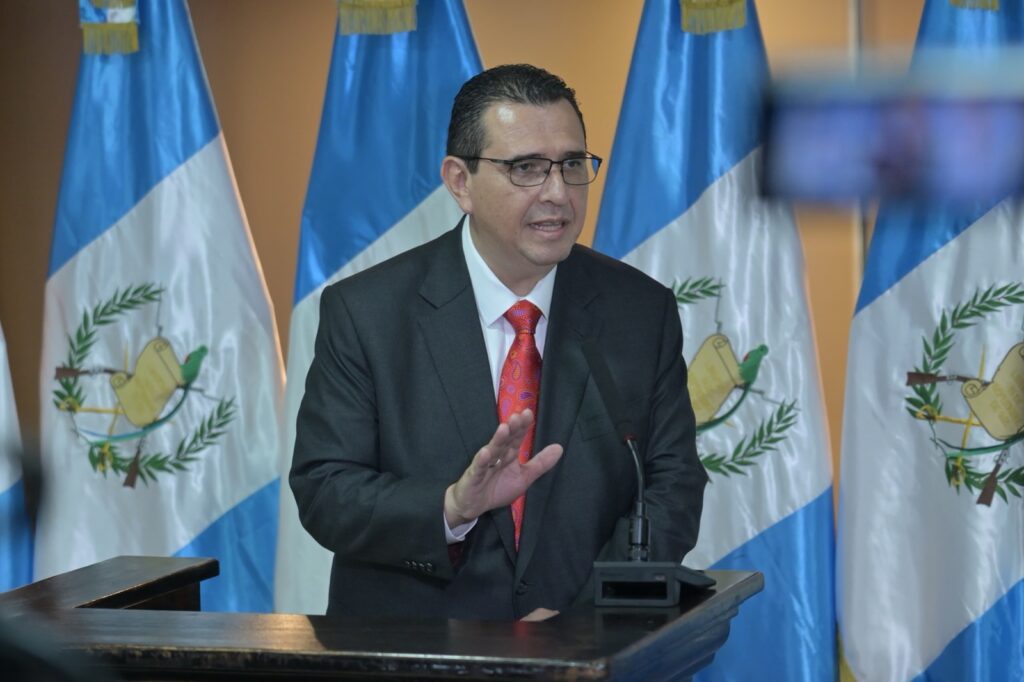
On 17 May, Guatemala’s new Attorney General, Gabriel García Luna, took office. His appointment raises hopes for change in the justice system, following the disastrous tenure of the outgoing Attorney General Consuelo Porras – who has been sanctioned by more than 40 countries for a pattern of the obstruction of justice, particularly aimed at undermining democracy and the rule of law.
The new Attorney General will face major challenges in restoring the independence of the Public Prosecutor’s Office (Ministerio Público, MP) and rebuilding public confidence in the justice system. He must define a new criminal policy focused on the crimes that most affect the country, such as corruption, organised crime, extortion, homicides, violence against women, and the serious human rights violations committed during the internal armed conflict. Furthermore, he must put an end to the political persecution and criminalisation of journalists, human rights defenders, former justice operators and Indigenous leaders, that was initiated by former Attorney General Consuelo Porras.
“This is a time to learn from our history. Justice has all too often been a tool of revenge. It is time to leave that past behind.” —President Bernardo Arévalo
Crucial election processes to rescue justice
The process for selecting the Attorney General took place between January and May 2026, and was subject to intense political pressure from sectors seeking to unduly influence the process. In the first stage, a nomination committee – comprising 15 members, twelve of whom were deans of law from the country’s universities – selected six candidates from a total of 59 applicants; and in the second stage, President Bernardo Arévalo chose the Attorney General from the list of six candidates received from the nomination committee.
The process was observed by Guatemalan civil society organisations and by three international missions: the Special Mission of the Organisation of American States (OAS), the Technical Mission of the European Union (EU), and the Panel of Independent Experts (PEI), promoted by international civil society organisations such as CEJIL, DPLF and Impunity Watch, amongst others.
Impunity Watch directly observed the sessions of the nominating commissions, and offered technical advice to the National Platform of Victims, and the Indigenous Authorities on the development of the selection processes. We prepared informative reports for the international missions, and shared reports with the Special Rapporteur on the Independence of Judges and Lawyers, Margaret Satterthwaite, and the Inter-American Commission on Human Rights. We also hosted an online campaign to inform the public and the international community about developments.
This election coincided with three other election processes of significance for the country: the election of the Electoral Tribunal; the election of the Constitutional Court; and the election of the rector of the University of San Carlos of Guatemala, the country’s only public university, which influences various areas of state decision-making.
In general, the election processes have unfolded against a backdrop of political tension: a struggle between corrupt groups seeking to maintain the current status quo, and democratic groups pushing for renewing the courts and institutions.
Read: Bulletin on the election process of judges (Spanish)
One of the most striking aspects was the participation of Porras in the process, who was seeking a third term as Attorney General (which she luckily failed to secure), and the Constitutional Court’s decision to exclude career judges from the process based on a narrow interpretation of the Constitution, thereby excluding candidates with valuable professional experience in the judiciary.
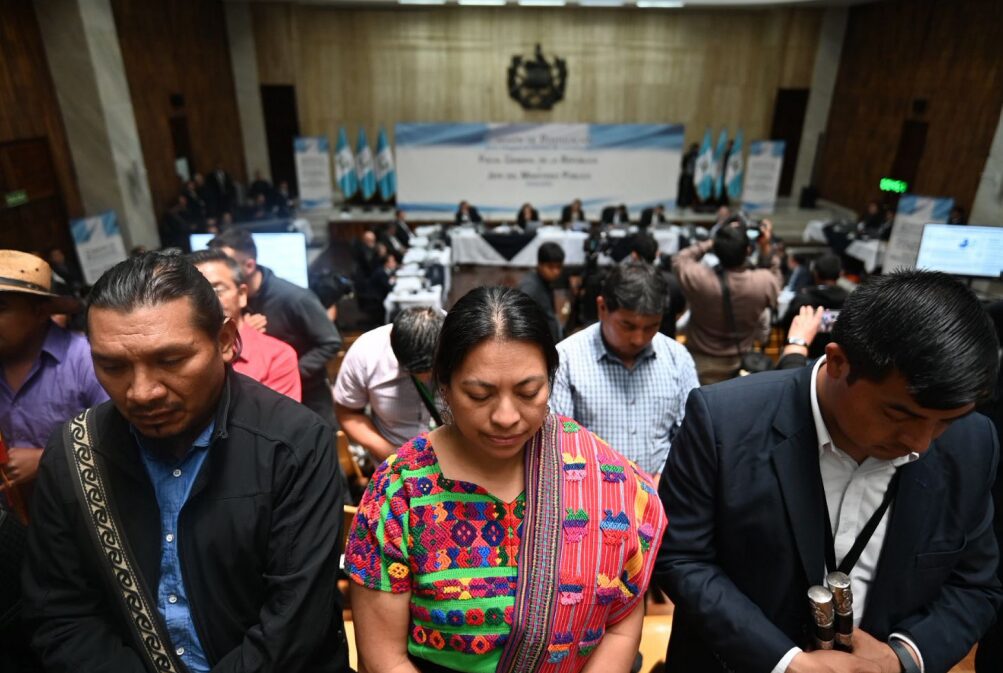
Indigenous authorities and civil society turned their backs on Consuelo Porras during her interview before the Nominating Commission.
Consuelo Porras’s disastrous legacy of dismantling justice comes to an end
Consuelo Porras will be remembered as the worst Attorney General in Guatemala’s history. During her eight-year tenure (2018–2026), she protected powerful political and economic groups and obstructed investigations into corruption, organised crime and human rights violations. She turned the Public Prosecutor’s Office into an instrument of political persecution to criminalise justice operators, journalists, Indigenous leaders and human rights defenders. As a result, more than 60 people were criminalised and over 100 were forced into exile.
Porras dismantled key prosecution units such as the Special Prosecutor’s Office against Impunity (FECI), responsible for following up on corruption cases investigated by the International Commission against Impunity (CICIG), the Anti-Corruption Prosecutor’s Office, the Organised Crime Prosecutor’s Office and the Human Rights Prosecutor’s Office, responsible for investigating cases related to the internal armed conflict. She dismissed more than 500 prosecutors and staff from the Public Prosecutor’s Office and replaced them with individuals who were incompetent and willing to protect the corrupt and persecute the innocent.
According to the study, ‘Efficiency or Impunity’ (INECIP 2025), impunity for serious crimes surpassed 94% during her tenure, signalling a staggering lack of justice and accountability.
Porras dismissed 74% of the complaints filed in the Public Prosecutor’s Office without any investigation whatsoever. Furthermore, she used the Prosecutor’s Office against Land Grabs to violently evict dozens of Indigenous communities from their territories.
In 2023, she further sought to jeopardise democracy. She attempted to annul the election results in which President Arévalo was elected, and criminalised the judges and staff of the Electoral Tribunal. Furthermore, she criminalised the Indigenous Authorities who took part in the peaceful demonstrations of 2023 to defend democracy. Indigenous leaders Luis Pacheco and Héctor Chaclán have been in prison for over a year for this case.
In 2024, Porras was sanctioned by the European Union and other countries for undermining democracy and the rule of law; and international human rights bodies, such as the Inter-American Commission on Human Rights and the United Nations High Commissioner for Human Rights, have condemned the manipulation of the criminal justice system for political ends to criminalise human rights defenders, journalists and former justice operators in Guatemala.
More from JusticeInfo: ‘The fall of Consuelo Porras’
Challenges faced by the new Attorney General
Gabriel García Luna has worked in the justice system for over 25 years. He served as a justice of the peace and a judge in the criminal court of first instance for nine years, then as a judge on the Court of Appeal in Alta Verapaz, and since 2024 has been a legal adviser at the Office of the Solicitor General (Procuraduría General de la Nación, PGN). He is known as an honest and sincere person, which is why his appointment raises hopes for change within the Public Prosecutor’s Office and the justice system.
Read: Challenges to restoring public trust (Spanish)
Among his first actions as Attorney General, he announced that he would close the Special Prosecutor’s Office against Impunity (FECI) because it had lost credibility with the public, and that he would create a special commission to review cases of criminalisation. Furthermore, he announced that he would carry out an internal review to assess the work of the institution’s prosecutors and administrative staff, and that he would maintain greater transparency and communication with the media.
In March, we organised a forum in Guatemala on the relevance of these selection processes, and the challenges of restoring the Public Prosecutor’s Office, with the participation of the Vice President of the IACHR, Andrea Pochac, and representatives of civil society, Indigenous peoples, and the business sector.
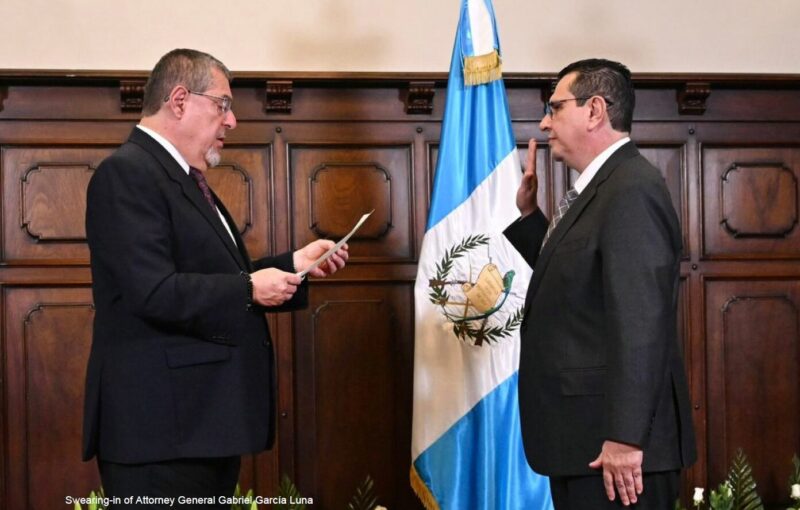
These announcements are positive, but the new Attorney General will undoubtedly need to assemble a strong team to carry out the restructuring of the Public Prosecutor’s Office and resume the fight against impunity, particularly to prosecute crimes with a significant social impact, such as corruption, organised crime, homicides and violence against women. He must also close cases of criminalisation so that political prisoners can regain their freedom and those in exile can return safely to the country.
*
We are currently organising a webinar on lessons learned from the electoral processes and proposals for reforming the court system in Guatemala, with representatives from the three international missions and the Special Rapporteur on the Independence of Judges and Lawyers. Stay tuned to our channels for more information.