


13 August 2024
In Guatemala, the actions of the Public Prosecutor’s Office continue to threaten democracy and criminalise human rights defenders, former justice officials, independent journalists, Indigenous leaders, and current government officials.
Amid this backdrop, recent visits of the UN High Commissioner for Human Rights, Volker Türk, and the Inter-American Commission on Human Rights (IACHR) to Guatemala occurred at a crucial time.
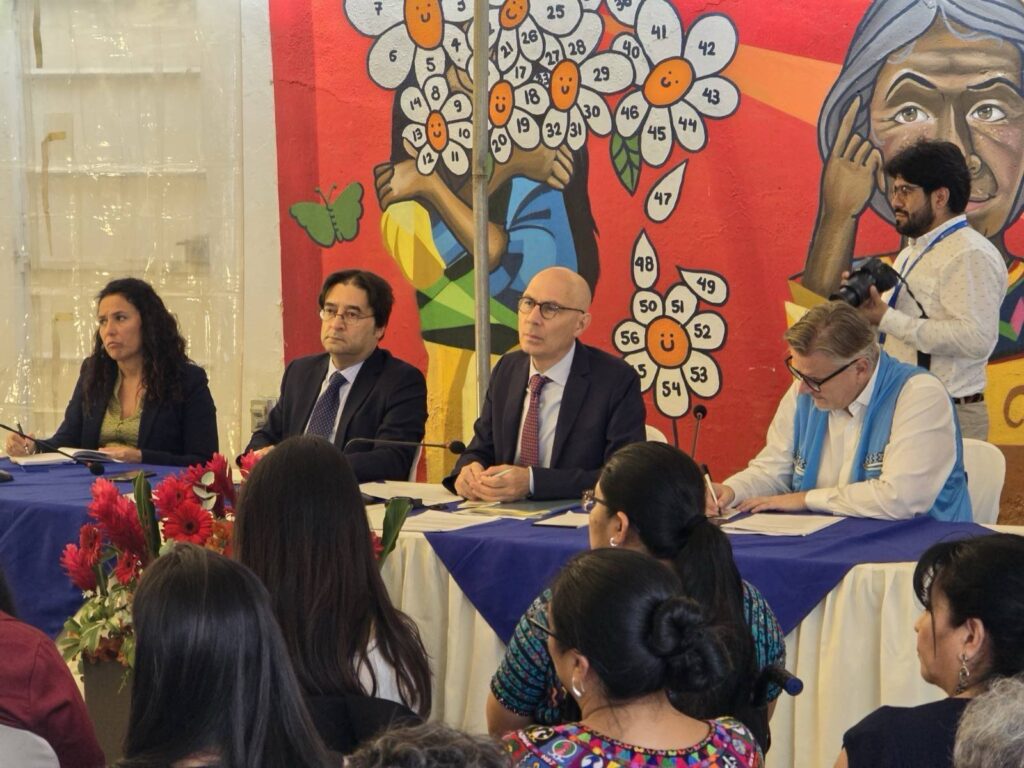
The High Commissioner visited Guatemala from 16-19 July, and met with President Bernardo Arévalo and other government officials, representatives of civil society, Indigenous authorities, as well as representatives of the business sector and the international community in Guatemala. In addition, he travelled to Totonicapán to meet with the Indigenous authorities of the 48 Cantons, who led of the 2023 protests to defend democracy.
UN High Commissioner: “The efforts of Indigenous peoples have successfully preserved democracy”
Türk said he decided to visit Guatemala because it is a crucial moment in history and he wants to support the efforts to strengthen democracy and the rule of law, fight corruption, and establish a clear and transformative human rights agenda in the country.
“What happened during the 2023 electoral period has been of utmost concern to me. I feared that the regressive forces who had co-opted the State structures would also succeed in overturning the popular will expressed at the ballot box. The efforts and determination of many sectors of the society, especially the 106-day mobilisation of Indigenous Peoples and social movements, have been successful in preserving democracy and the rule of law. It was an honour to meet some of them this week.” – Volker Türk, UN High Commissioner for Human Rights
Alarmed by the criminal persecution of human rights defenders, former justice officials, independent journalists, students, academics, and current government officials, Türk urges the Attorney General to end the criminalisation of these groups: “Dozens have been criminalised and face judicial proceedings based on spurious grounds. More than 50 individuals have been forced to leave the country due to fears for their safety and live in exile as refugees. They are victims of persecution, and their cases are a matter of international concern and an issue of accountability for human rights violations. I urge the Attorney General to adopt the necessary measures so that this persecution ends immediately. All those in exile should be able to return immediately and in safe conditions.”
The High Commissioner also expressed his concern about the situation of victims and survivors of the internal armed conflict and the slow progress of transitional justice cases. He noted that the Peace Accords, in particular the non-repetition measures, have not been fully carried out. Finally, he called on the international community to continue supporting Guatemala in its efforts to strengthen democracy, the rule of law and respect for human rights.
IACHR expresses concern over the criminalisation of human rights defenders
Following this moment, the Inter-American Commission on Human Rights (IACHR) visited Guatemala from 22 – 26 July, meeting with President Bernardo Arévalo and other government officials, members of Congress, judicial authorities, and Public Prosecutor Consuelo Porras. The representatives also met with civil society organisations, Indigenous leaders, journalists, and individuals who have been criminalised while visiting the departments (provinces) of Alta Verapaz, Izabal, Petén, Sololá, Tononicapán, San Marcos, and Quetzaltenango. The IACHR representatives also visited former prosecutor Estuardo Campo and journalist José Rubén Zamora in prison, both of whom have been unjustly imprisoned because of their anti-corruption work.
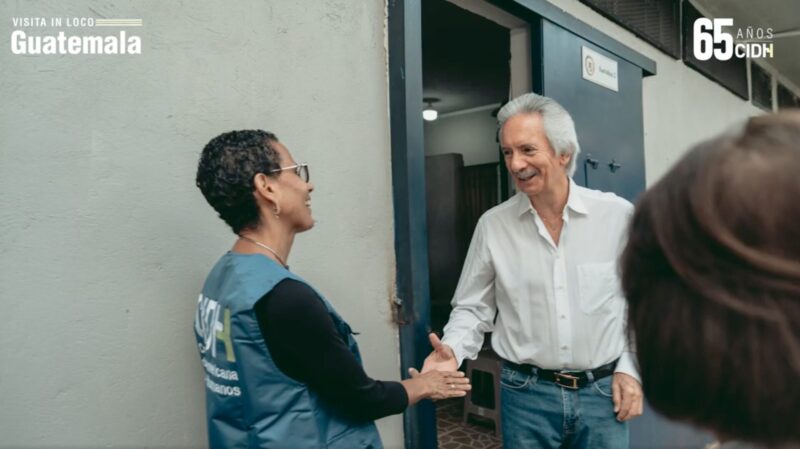
Photo credit: IACHR
The IACHR last visited Guatemala in 2017, during the government of President Jimmy Morales. Since then, the Commission has expressed concern about criminalisation and the growing crisis in the justice system. Since 2021, the IACHR has included Guatemala in Chapter IV.B of its annual reports, along with other countries that systematically violate human rights, such as Cuba, Nicaragua, and Venezuela. The IACHR has also strongly opposed the criminalisation of human rights defenders, former justice officials, journalists, students, academics, and Indigenous leaders.
In a closing statement, the IACHR spoke out against the manipulation of the justice system to generate a climate of fear and criminalise human rights defenders, government officials and other members of civil society.
“In Guatemala, the criminal justice system has been used against human rights defenders, as well as against those who participate or have participated in peaceful demonstrations and social protests to defend democracy and the rule of law, or have participated in the fight against corruption and impunity. Of particular concern is the abuse of the criminal justice system against justice operators, human rights defenders, legislators, journalists, students, academics, members of political parties, public officials and even against the President and Vice President of the Republic, as well as members of Indigenous, peasants, and trade union organizations. The Inter-American Commission is deeply concerned about the number of justice operators and their legal representatives that are facing criminal charges. Many of them were part of the CICIG and the Special Prosecutor’s Office against Corruption and Impunity (FECI). Also, former judges and prosecutors who heard cases related to the internal armed conflict and/or corruption while serving on the high-risk courts are in the same situation; as are magistrates of the Supreme Electoral Tribunal.”
Hear directly from Indigenous leaders and civil society actors on why the visit of the IACHR came at a crucial moment in time:
Recommendations to the State of Guatemala centered on the role of the Prosecutors Office
The IACHR presented 10 recommendations to the State of Guatemala to improve the human rights situation, five of which refer to the role of the Public Prosecutor’s Office and an end to criminalisation. The IACHR recommended an independent review of the operations of the Public Prosecutor’s Office and the impact on human rights, while also recommending measures to allow for those living in exile to safely return to the country.
Regarding the election process currently underway for the Supreme Court and the Appeals Courts in Guatemala, the IACHR recommended compliance with terms as defined by law and that the process be carried out with in an objective, public and transparent manner.
The Commission expressed concern regarding the situation of Indigenous Peoples due to the high levels of poverty, precarious situations, uncertainty, displacement, and discrimination, all challenges awaiting adequate policies to address them since the signing of the Peace Accords.
In the next few months, the IACHR will publish a complete report on the visit with their recommendations to the State of Guatemala, as well as a mechanism for addressing and follow-up on those recommendations.

The Impunity Watch team in Guatemala participated in the meetings with the High Commissioner and the IACHR, along with civil society. We also supported organizations of victims of the armed conflict and civil society organizations in preparing for both visits, particularly in preparing the main messages and demands more clearly as victims and civil society to be presented to the High Commissioner and the IACHR. We will monitor the implementation of the recommendations of both missions.
Official statements about the visits are available here:
UN Human Rights Chief Volker Türk concludes official visit to Guatemala | OHCHR
IACHR: Press conference On-site visit to Guatemala (in Spanish)
IACHR Announces On-Site Visit to Guatemala
Explore our work in Guatemala