


15 March 2026
In Guatemala, victims and survivors of the country’s internal armed conflict and civil society organisations (CSOs) lead the fight for justice.
Yet they consistently face structural barriers, from limited resources and a lack of political will, to structural racism embedded within co-opted justice institutions and the criminalisation of Indigenous human rights defenders.
In this context, resistance against systemic impunity takes the form of victims’ mobilisation to keep up the pressure for accountability, enabling windows to drive institutional change through strategic actions at opportune moments and in cooperation with key allies.
Victims demand institutional reform and reparations
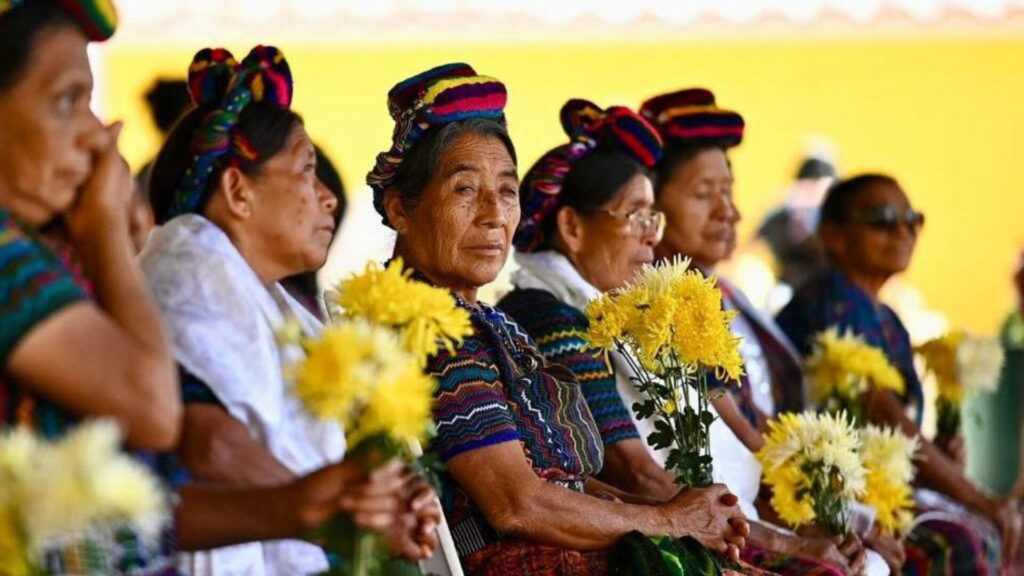
The National Day of Dignity for Victims of the Internal Armed Conflict in Guatemala is an annual day honoring over 200,000 victims of the 1960-1996 civil war—mostly Indigenous Maya—by demanding justice, truth, and reparations.
On 25 February 2026, victims honoured the memory of their loved ones who disappeared and died during the war. Commemorative events were held in Guatemala City and in seven regions of the country: Chimaltenango, Cobán, Nebaj, Patulul, Rabinal, Santa Cruz del Quiché and Uspantán. Victims held invocations based on the Mayan worldview, masses, and discussions, reading a joint statement from the National Platform of Victims:
“We, the victims and survivors, continue to demand justice for the atrocities of the armed conflict. That is why we are closely following the processes for electing the attorney general and the judges of the Constitutional Court. We do not want justice to remain in the hands of corrupt persons who have been sanctioned internationally.”
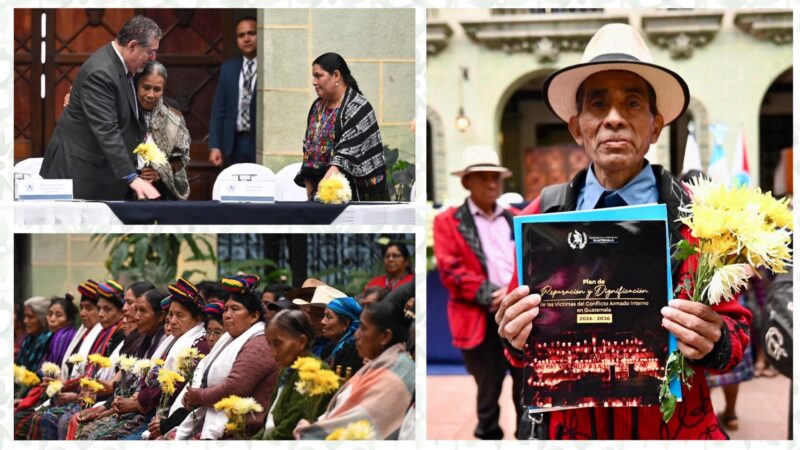
At the National Palace, President Bernardo Arévalo announced the creation of the Reparation and Dignity Plan for Victims of the Armed Conflict 2026-2036. This plan is the result of two years of dialogue between the government and the National Platform of Victims, with the support of Impunity Watch and the Office of the High Commissioner for Human Rights in Guatemala. It is based on a comprehensive approach and includes reparations such as financial compensation, material restitution, and psychosocial assistance for victims, among others. President Arévalo emphasised that “it is not enough for the commitments to remain on paper; the plan must be put into action so that it reaches the victims most in need.”
In his speech, the director of the Presidential Commission for Peace and Human Rights (COPADEH), Elvyn Díaz, stated that: “COPADEH will ensure its effective implementation, because we cannot talk about lasting peace if reparation policies are treated as temporary handouts rather than permanent State commitments.”
Feliciana Macario, representative of the National Platform of Victims, pointed out that:
“The Plan is an important step towards fulfilling the rights of thousands of victims who have been abandoned by recent governments. The creation of the Plan took two years, and we are concerned that this Government only has two years left to implement it, while victims continue to die without even receiving a public apology.”
Reparations remain pending, a decade after the Sepur Zarco case
The Sepur Zarco case set a global precedent for international justice, as it was the first time that sexual violence and domestic slavery against Indigenous women were recognised as systemic weapons of war and crimes against humanity.
Ten years after this groundbreaking ruling, challenges remain in the implementation of comprehensive reparations. The court had approved 18 reparation measures aimed at restoring dignity to the victims, rebuilding their individual and community life projects, and promoting historical memory to ensure non-recurrence of violations.
On 26 February 2026, to mark the 10th anniversary of the sentence in the Sepur Zarco case, Impunity Watch, the Jalok U Collective (formed by the survivors of the case) and the organisation Mujeres Transformando el Mundo (MTM, Women Transforming the World) held an event entitled ‘10 years since the Sepur Zarco sentence: A milestone for justice and transformative reparation’ at the National Palace of Culture. The Minister of Culture and Sports, Liwy Grazioso; the Secretary for Women, Ana López, survivors of the case, representatives of UN Women, OHCHR, the international community and civil society organisations participated.

Brisna Caxaj of Impunity Watch presented the most relevant findings of the study ‘Justice and Reparation in the Cases of Sexual Violence in Sepur Zarco and Achi Women’, highlighting the leading role played by the survivors in their leadership and determination to seek justice. She also pointed out that a feminist and intersectional approach was key to understanding the severity of sexual violence in armed conflict, which was used to break down the social fabric of communities and impose terror on indigenous communities. This approach also provided a basis for the application of the transformative reparation model, given the complexity of the damage caused by sexual violence.
Stay tuned for our release of this report, co-funded by the Global Initiative Against Impunity and the European Union.
Demecia Yat, a survivor in the case, lamented that 10 years after the sentence, the reparation measures have not been fully implemented, and their sustainability is not assured:
“We are not going to be travelling every year, as survivors, to ensure that the reparation measures are implemented. To come to the capital, we have to travel all day. We want the reparation measures to be implemented.”
Minister Liwy Grazioso affirmed that the Ministry she heads will continue to promote the implementation of the sentence, and that one tool for this is the Dignity and Reparation Plan. She acknowledged that it is sad that ten years have passed and the ruling has not been fulfilled.
The event was also attended by survivors of the Maya Achi Women’s case, who were inspired by the example of the Sepur Zarco survivors to seek justice. Both cases are examples of the struggle of Indigenous women and survivors of sexual violence to seek justice and dignified reparation for themselves, their families, and their communities.
Restoring the Achi Women’s mural for historical memory
In 2023, a mural was painted in Rabinal, Baja Verapaz in recognition of the 36 Achi women who achieved justice for the sexual violence they suffered during the internal armed conflict (between 1981-1983). It was one of the reparations granted in the Achi Women’s case, with the sentencing of five former paramilitaries to 30 years in prison for crimes against humanity and sexual violence in January 2022. Unfortunately, in July 2025, the mural was erased by the same municipality that had authorised it to be painted in the town centre two years prior.
On 7 March 2026, ahead of International Women’s Day, the Community Legal Firm (ABJP) of Rabinal and Impunity Watch succeeded in having the mural repainted. The event was attended by the survivors, their lawyers, the Presidential Commissioner against Racism and Discrimination (CODISRA), representatives of the Presidential Commission for Peace and Human Rights (COPADEH), the Office of the Ombudsman for Indigenous Women (DEMI), victims’ organisations and civil society.
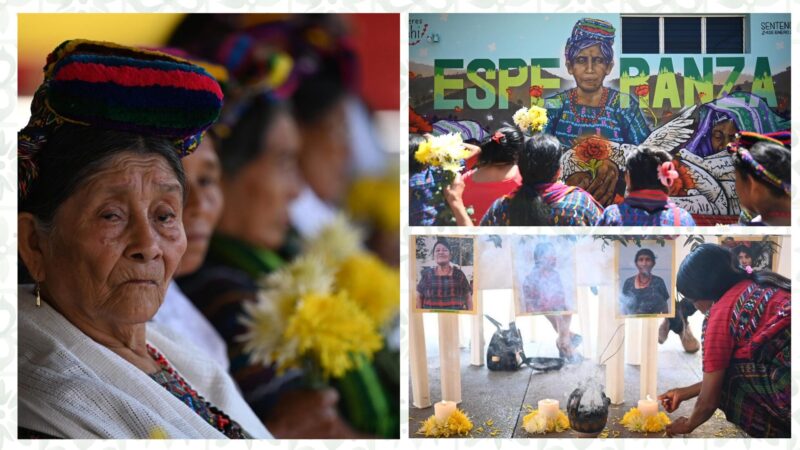
The restoration of the Maya Achi mural is crucial for promoting historical memory, contributing to the healing and dignification of the victims. It ensures that the case is widely known so that such violence is not repeated, and publicly recognises the tireless courage and persistence of the victims in their decades-long struggle for justice.
The day began with an invocation of the day from the Mayan worldview, 5 K’at, a day to pray for abundance and for the paths to be untangled. After representatives of the organisations and institutions lit the candles on the altar, survivors who have already passed away were remembered: Rosalina Sic Chen, Rufina Alvarado Chajaj, Pedrina Vargas Ixpatá, Ceferina Román López, Natalia Ixpatá Sic and Jesusa Osorio Sánchez, and seven volunteers from the survivors lit a candle in their memory.
During the event, Lucia Xiloj, one of the lawyers in the case, handed out the second ruling in the Achi women’s case to representatives of state institutions, which saw three other former paramilitaries sentenced for the same crimes in May 2025. In addition, the Court ordered 19 transformative reparation measures. As she handed out the sentence, lawyer Xiloj appealed to the State’s commitment to implement the reparations measures ordered in both trials, as it is the victims’ right and they have waited many years for justice and reparations.
In her speech, Paulina Ixpatá, one of the survivors, emphasised the importance of reinstalling the mural for them and its significance in representing their story, their voice and in remembering what happened during the armed conflict. She called on State institutions to comply with the other reparation measures. The coordinator of the Impunity Watch office in Central America, Denis Martinez, emphasised the commitment to continue supporting the survivors and the importance of historical memory so that these crimes are not repeated.