


8 July 2025
“We only need to turn on the news today to see the imprint of militarised masculinities on the world in real time.” – Philipp Schulz, post-doctoral researcher at the University of Bremen
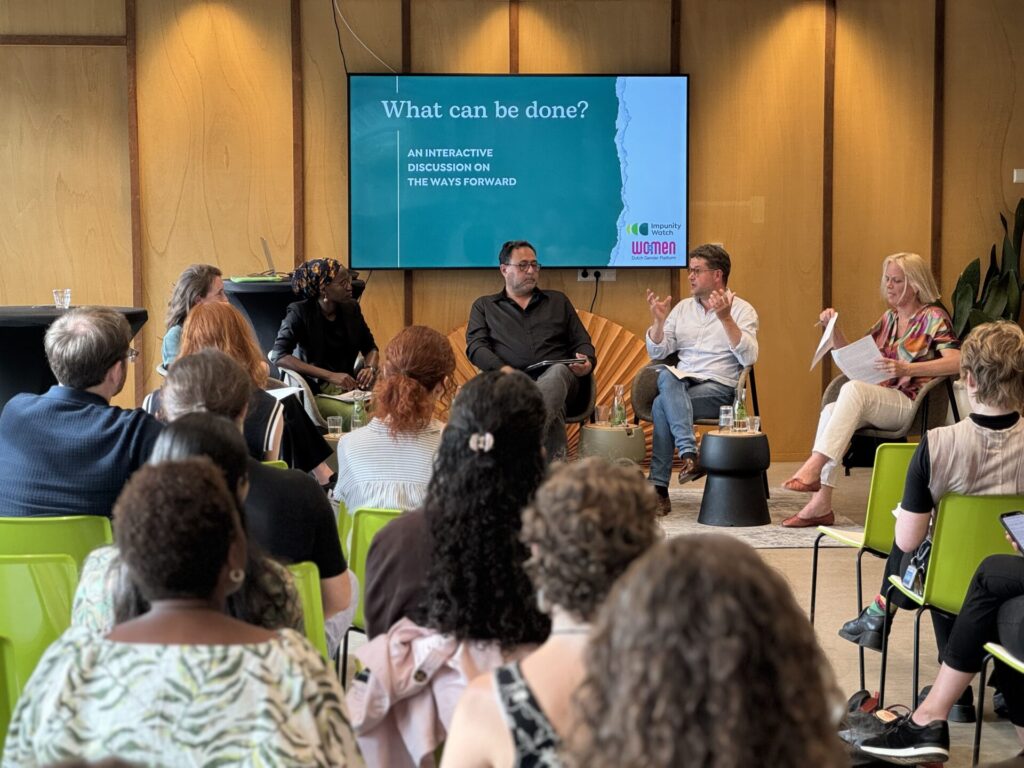
Our most recent event, “Which masculinities for a fairer and safe world?”, was held on 17 June at a timely moment, ahead of the NATO summit in the Hague. Co-hosted by the Dutch Gender Platform WO=MEN, we invited people to come together and unpack the concept of violent and militarised masculinities, identified by many victims’ groups as a root cause of impunity and gender inequality. In the process, we animated a conversation about potential solutions that can contribute to systemic change and transformative justice.
What do we mean by ‘violent and militarised masculinities’?
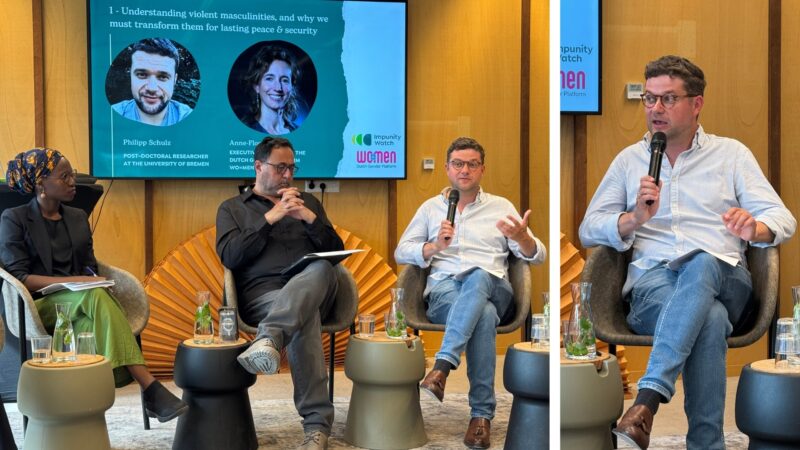
Philipp Schulz, the lead researcher on an upcoming series of Impunity Watch’s reports on the ‘Linkages between Violent/Militarised Masculinities and Impunity’, opened by explaining the concept: “At its core, militarised masculinities connect ideals of manhood with military service and combat, normalising the use of violence, force, and oppression.”
It’s important to note that this is not a recent phenomenon, nor are these norms confined only to armed forces or actions – they are a broader societal problem, reproduced in institutions and cultures, such as the police force in Guatemala, discourses within NATO, or by policymakers reproduced in the media.
“When the systems reinforce these types of violent masculinities, it becomes a breeding ground for impunity. It must be the global priority of institutions [like NATO] to break these cycles.” – Philipp Schulz
Even key transitional justice frameworks – such as the 2023 UN guidance note on transitional justice, or the African Union Transitional Justice Policy – do not attend to militarised masculinities at all. In this sense, core justice actors, including Human Rights inquiry bodies, can be entry points to influence international institutions and states to recognise and address militarised masculinities as a root cause of violence.
Transforming masculinities to support stronger democracies
The discussion on the importance of integrating masculinities perspectives on gender transformation also is timely because it happens as we commemorate the 25th anniversary of the Women, Peace, and Security (WPS) agenda – established by UN resolution 1325, it was a historic turning point in recognizing women’s and girls’ status, rights and position in relation to peace and security.
The continued support to civil society for collective building of stronger and caring democracies, especially feminist organizations and movements, such as the Dutch National Action Plan on WPS (NAP 1325), is another key response to addressing militarised masculinities.
Anne-Floor Dekker, Executive Director of WO=MEN, coordinates the NAP 1325: a unique collaboration between 60+ civil society partners and four ministries. Together, they make agreements about the implementation of the WPS agenda in the Netherlands, including pushing forward the discussion on masculinities. However, this comes at a challenging time: despite NATO adopting a new WPS policy in 2024, it was not on the Summit’s agenda this year.
“We live in a new reality, where the strongest member of NATO [the US government] is glorifying militarised masculinities. The NATO alliance was built to protect democracy, rule of law, and human rights, but it is straying from such priorities, for example in the proposed increased spending of military budgets. What do we want to protect? There seems to be no wish to prevent armed conflict, and hardly any checks and balances.” – Anne-Floor Dekker
Amid worsening global crises and increased militarization, we signed on to a joint letter with 120 civil society organisations calling for stronger commitments to prevent violence and conflict that disproportionately affect women and marginalized groups.

The ongoing increase in investments in the military-industrial complex is one clear evidence of the systemic roots of the issue, with direct impacts on the persistence of impunity. Addressing such structural problems requires the reinvention of militarised masculinities around human security and conflict prevention.
Anne-Floor highlighted the important work being done in this crucial space, emphasizing that Impunity Watch is among only a few organizations among the 60+ NAP 1325 signatories who are working on transforming masculinities. Another example is Dutch NGO PAX, which spearheads a Community of Practice on men, masculinities, and feminist peace together with Geneva-based WILPF (Women’s International League for Peace and Freedom). Anne-Floor hopes that through such collective work, that there will be not only more recognition, but also more specific interventions related to integrating masculinities in the newest NAP 1325 reports, and urges that this is something that must be taken up at the policy level, including within Dutch ministries.
Breaking out of the ‘warrior’ mindset
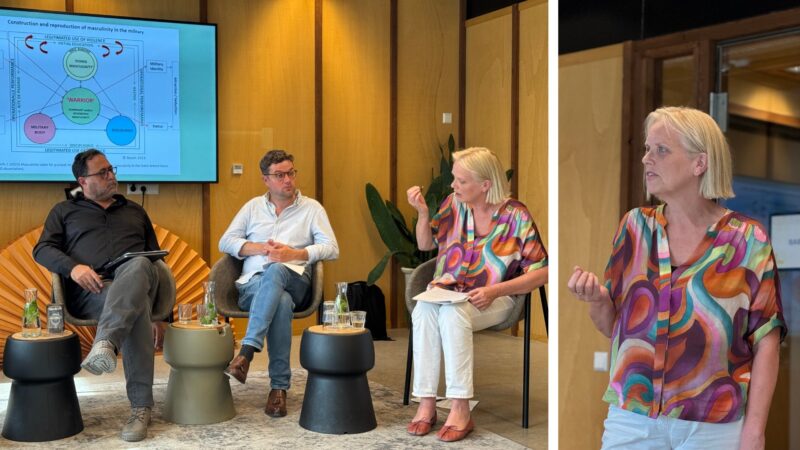
Speaking at the event, Jolanda Bosch, professor of Military Ethics at the Netherlands Defense Academy went deeper into the construction of masculinities in the military. The combination of three factors: 1) ‘Doing’ masculinity (e.g. male bonding within the military) 2) Discourses around masculinities (e.g. displaying toughness or lack of emotion), and 3) The physical and symbolic military body as it relates to identity and rules (e.g. uniformed, classified) are all taken for granted, but also become avenues to discuss masculinity. In particular, she explained that the absorption of norms in the process of becoming a soldier, forms a significant part of the individual’s identity – known as the ‘warrior mindset’.
In Burundi, where perpetrators of past atrocities live side-by-side with their victims, Impunity Watch focuses on how militarised masculinities impact the fabric of the entire community and seeks to prevent future violence. Such communities are also left behind, with no attempts to facilitate a return to civilian life for many in need.
Christella Niyonzima, head of programmes at Impunity Watch in Burundi, explained the different dimensions of our work with partners in this space – to understand the militarisation of youth, we work on the role of education, intergenerational dialogue, and mental health and psychosocial support (MHPSS) to foster truth, justice and reconciliation.
“The limitations of many disarmament, demobilization and reintegration (DDR) processes are that they are not inclusive of the human dimensions. [Through these activities], people understood that everything that happened in the community affected us all. To rebuild the country, we must all be involved.” – Christella Niyonzima

Christella explained that through positive masculinities trainings, coupled with MHPSS support, ex-combatants learned the value of alternatives to violence for themselves and their communities. The impact of this mindset shift is felt throughout society, shared not only by individuals in their testimonies but also by their families as they manifest through the conscious altering of behaviours in daily life – thus actively breaking out of the ‘warrior’ mindset.
Various participatory action research by Impunity Watch and other actors increasingly highlight how violent and militarised masculinities underlie the systemic violence that affects post-conflict societies in general, which impacts especially vulnerable groups more deeply.
Established processes and mechanisms aimed at dealing with the past and conflict transformation have yet to systematically and strategically integrate, among other aspects, the transformation of masculinities for more egalitarian societies. Moreover, this cannot only be done by formal or institutional mechanisms – it requires continuous effort to re-think ‘dealing with the past’.
So, what can be done to transform masculinities?
Throughout the discussion, many more encouraging examples of change were brought up. Philipp mentioned the Colombian Truth Commission, and its commendable recognition of the impact of militarised masculinities on decades of conflict, and explicit linkages of these to continuums of gender-based violence. Continuing to build alliances with actors at different levels of society, from the grassroots to the institutional, is vital for mobilising progress.
Both Jolanda and Christella identified how such discourses on gender roles are also passed down across generations. In the Dutch military, women were also only more willing and comfortable to discuss their perspectives when ‘masculinities’ were first brought up. Thus, there is a need to continue facilitating more intergenerational conversations and opening up spaces within institutions to speak on these topics. As Anne-Floor simply put it, “If you want to organise equal power relations and stop cycles of violence, you need the involvement of all of society.”
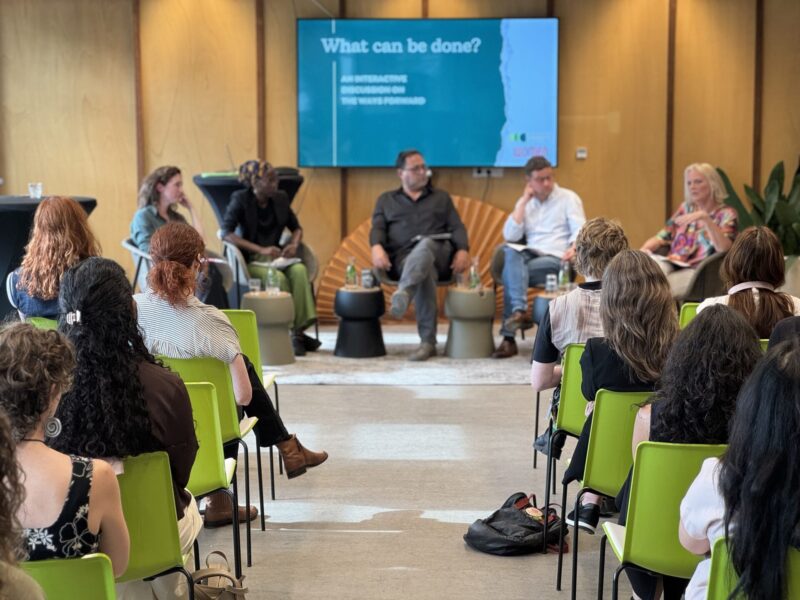
Finally, it was agreed that a deeper engagement with the structural causes, not only targeting those that once hold a gun, is necessary to break cycles of violence in a consistent and sustainable manner – from linking inter-ethnic conflicts to colonialism, to questioning heteronormativity and gender binaries, and even interrogating the underlying business interests in increased defense spending such as arms trade.
**
Want to be the first to find out about our upcoming research on the ‘Linkages between Violent/Militarised Masculinities and Impunity’? Sign up to our newsletter today!