


8 February 2024
Artistic initiatives have become central to our Burundi programme’s transitional justice strategies. An important part of this involves young people discovering their history and the antecedents to some of the country’s worst periods of violence. In this way, artistic initiatives have the power to address complex and sensitive subjects in a subtle, less confrontational way, particularly in contexts of extreme violence and polarisation.
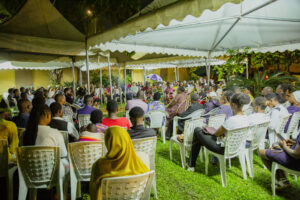
On 26 January 2024, Impunity Watch organised a photo exhibition and fireside discussion on Burundi’s history and the transmission and preservation of memories, in collaboration with Rweze, a collective of young women photographers and Troupe les Enfoirés de Sanoladante (TLES), a theatre group.
How do artistic initiatives confront the past?
The first artistic piece presented during the event was a visual booklet containing the script and photographs of a play, ‘IRAGI’ (Legacy). TLES worked with young people from across the country to create a theatre piece tackling issues of inherited memories and intergenerational traumas. The piece has been performed in all of Burundi’s 18 provinces, as well as a theatre festival in Bujumbura last year.
“We created this play based on both our diversity and our country’s past.” — Eric Niyoyitungira, a young actor from the Kirundo province
“The creation of the play IRAGI led me to understand that young people are not a homogeneous entity in terms of their reading of Burundian history. Even geographical differences between the youth were perceptible during the creative process.” — Josué Mugisha, TLES
Alongside the theatre booklet, we launched a photobook, titled ‘Portraits of the past and present: preserving memories through photography and storytelling’. Capturing the portraits and the personal histories of 22 elderly Burundians, Rweze uncovered untold stories of violence, of hope, of resilience and of heroism in Burundi since colonial times. The men and women who shared their stories were from diverse ethnic backgrounds and are all aged over 60 — this means the photobook contributes to preserving pieces of history that might otherwise soon be lost.

Explore the photobook: English French
A diverse audience attended the event, from young people, national and international partners, to donors and people interested in art and memory, with the youth and elderly people from the projects as special guests.
Drawing on traditional dialogue and storytelling practices, two stories were read from the photobook in a fireside discussion, followed by participation with the audience.
“A big thank you goes to the organisers of this event and to the people who agreed to share their lives. Burundians can know the facts of our country’s history through your stories,” said a young woman during the fireside chat.


Bringing generations together, redefining narratives
Beyond the immediate artistic work, the process in itself led the young participants to discover new truths.
“It was our first-time photographing people who had lived through quite sad stories and from all social categories. In Burundi, we’re not really used to talking openly about what happened during the years of crisis.” — Daniella Charissa Iradukunda, Rweze
The elderly people participating at the event expressed their joy at having their experiences acknowledged and their pride at the attention given to preserving and transmitting their memories:
“I was very collaborative because I felt there was a need to tell the truth about what happened in my country. It was my humble contribution to help young people be resistant and resilient in the face of manipulative politicians.” — Lazare Sagara, Mugongomanga (whose story can be found in the photobook)
The event provoked debate about why many families choose not to discuss memories and the country’s history with younger generations — and the consequences of this for young people. The fireside discussion brought many youth to face different narratives and interpretations of the past, including those forcing them to confront accepted truths and the complexity of their identity.
The reactions of the elderly people witnessing their portraits and personal histories being preserved for the first time touched both the youth in attendance as well as key policymakers:
“You are doing such important work for this country,” — Jerry V. Ruhangamura, one of the youth assisting the event
“These kinds of initiatives need to be multiplied, because not only do they reinforce social cohesion, they also heal the wounds of the past,” — a representative of the European Union
—–
These artistic initiatives were supported by the European Union, the Dutch Postcode Lottery, and the Embassy of the Kingdom of the Netherlands in Burundi.
Learn more: Our work in Burundi